SYSTEM STANDBY...
NET AREA // CENTRAL HUB
Playable games and published projects are ready to launch from this gate.
ORIGINAL WORLDS // READY TO LAUNCH
Select the questionnaire that matches why you are here. Each path opens its own protected Google Form.
Share your gaming attitudes, motivations, experiences, and hopes for the future of games and gaming culture.
For people invited to or interested in participating in Lexicon. Record consent, permissions, boundaries, and participation preferences.
Share how you engage with games, what you value in them, what you take away from them, and what you want from the future of games and gaming culture.
Test the proposed language gateway, localized introduction and consent, anecdotal questions, and final route structure before the live Google Form changes.
Preview only — entries typed here are not stored or submitted.
Select the language you want to use for this questionnaire.
このアンケートで使用する言語を選択してください。
Hello! My name is Akihito Chiba—an adventurer studying game planning at Human Academy Game College in Japan. I created this questionnaire to explore how people engage with games, what they value and think about them, and what they hope to see next. Your insights will deepen my understanding of how game design, storytelling, technology, and audiovisual presentation come together to shape the player experience. Thank you for sharing your gaming journey and knowledge!
Purpose: To understand how people engage with games, what they value in games, what they take away from them, and what they want from the future of games and gaming culture.
Estimated time: 10–15 minutes.
Response privacy: Google sign-in is required only to limit submissions to one response per account. Your email address will not be collected.
こんにちは!日本のヒューマンアカデミー・ゲームカレッジでゲームプランニングを学ぶ冒険者、千葉旭仁です。このアンケートは、人々がゲームとどのように関わり、何を大切にし、どのように考え、今後何を望んでいるのかを探るために作成しました。皆さんの声は、ゲームデザイン、物語、技術、映像・音響表現がどのように組み合わさり、プレイヤー体験を形づくるのかについて、私の理解を深めてくれます。あなたのゲームとの歩みや知識を共有してくださり、ありがとうございます!
目的:人々がゲームとどのように関わり、ゲームの何を大切にし、そこから何を得て、ゲームとゲーム文化の未来に何を望んでいるのかを理解すること。
回答時間の目安:10~15分。
回答のプライバシー:Googleへのログインは、1アカウントにつき1回の回答に制限するためだけに必要です。メールアドレスは収集されません。
The personal anecdotes remain in the respondent's chosen language and keep their original open-response format.
個人的なエピソードは、回答者が選んだ言語のまま、現在と同じ自由記述形式で回答します。
Page 1 is the language gateway. Each language then receives ten matching pages and ends at Submit form instead of entering the other language path.
Both language paths use the same Google Form and the same one-response protection.
The public questionnaire now contains complete English and Japanese paths in one shared form. Choose your language on page 1.
If the embedded form does not load, use Open Full Questionnaire above.
公開中の英語フォームは非表示です。日本語の回答ルートはまだ実際のGoogleフォームには実装されておらず、このローカルプレビューから回答は送信されません。
EVERY PERSON IS AN ENTRY.
Member-managed record
Classification // Member controlledCreator // Gamers' Grind
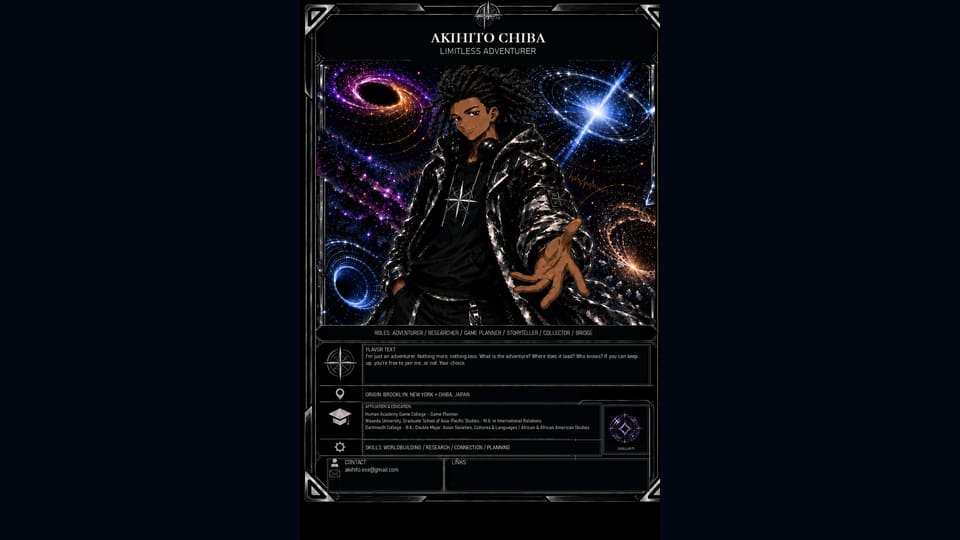
Akihito is a Brooklyn-raised creator with deep ties to Chiba, Japan, shaped by games, stories, cultural memory, travel, and the people encountered along the way. Study at Dartmouth and Waseda, together with time in South Korea, Ghana, and Japan, deepened his interest in how history, media, and systems shape what people inherit and what they carry forward.
Gamers' Grind is where those threads meet: an evolving record of games, ideas, people, and adventures, built to remember what came before, engage the present, and help create what comes next.
The instinct to explore was always present. These chapters trace the path through which Akihito eventually learned to name it: the Adventurer.
Before college, Akihito joined a high-school summer experience in South Korea through The Experiment in International Living and The Opportunity Network. It was an early step beyond the United States and part of the travel experience that later encouraged him to keep learning through place, language, culture, and daily life.
The Opportunity Network (OppNet)Akihito joined OppNet's six-year Fellows Program in 2016. The New York City community supports students from under-resourced and underrepresented backgrounds through college guidance, paid internships and enrichment, career preparation, mentoring, and lasting personal and professional networks.
A Continuing CommunityOppNet did not end with the South Korea program or high school. Its Fellows community and mentors, including Emmanuel Moses, remained part of Akihito's life through Dartmouth, Waseda, and beyond.
Dartmouth became a four-year humanities-centered era of study, community, work, travel, redirection, and friendships carried beyond campus. Akihito completed a Bachelor of Arts with a double major in Asian Societies, Cultures, and Languages and African and African American Studies.
FGLIFirst-generation and low-income student community.
FYSEPFirst-Year Student Enrichment Program, a pre-orientation and support community.
CollisDartmouth's central student gathering and involvement space.
Phi TauA gender-inclusive Greek society joined during senior year through friendship and shared interests.
OppNet FellowsThe college years continued the six-year OppNet Fellows journey that began in 2016, carrying advising, career preparation, mentoring, and community into Akihito's life at Dartmouth.
Akihito's first stay in Japan centered on Japanese 22 and 23, a Japanese topics course, cultural activities, and homestay life through Dartmouth's Language Study Abroad Plus program at Kanda University of International Studies. He lived with a host family in Masuo, Kashiwa, Chiba, and the distance from campus gave family life and the local area unusual importance.
Keepsake His host family created a hardcover album of photographs, drawings, and messages remembering their time together and awaiting his return.
Akihito traveled to Ghana to better understand roots his family connected to the country. Dartmouth's African and African American Studies Foreign Study Program combined coursework at the University of Ghana, Legon, with homestay life, archives, community research, and travel through Accra, Kumasi, northern Ghana, and historic coastal sites.
The journey brought a surge of complicated emotions. The lesson was not to erase or be consumed by them, but to understand their place in remembering what and who came before, and in considering what and who comes after.
Keepsakes A necklace, Ashanti cloth, a handmade band, a custom bag, photographs, and a portrait in traditional kente cloth.
After the FSP, Akihito remained in Accra for a three-month legal assistant internship with Law and Development Associates, a multidisciplinary law, policy, and development consultancy. The work shifted daily life from a student group toward Ghanaian colleagues, clients, and professional practice.
The full Ghana stay raised questions about visibility, normalcy, independence, control, inherited systems, and whether moving forward requires breaking from the past, carrying parts of it, or navigating a spectrum between both.
COVID-19 arrived after Ghana, during the latter half of junior year and into senior year. Life narrowed physically, first at home in Brooklyn and later in an off-campus apartment near Dartmouth, while the desire to remain connected became stronger.
Advice from Phi Tau alumni challenged the assumption that law school had to come next. One alumnus pointed toward Waseda's Graduate School of Asia-Pacific Studies and a route closer to Akihito's interests in popular culture, media, and reception.
Akihito entered Waseda University's Graduate School of Asia-Pacific Studies in late October 2022, pursuing a master's degree in International Relations through Professor Seio Nakajima's popular culture seminar. Waseda provided the academic route, research structure, and degree, but the university itself was not the center of this era. Most of its meaning came from the people, communities, fieldwork, and adventures Akihito found beyond campus.
Returning to Japan required trust. A Dartmouth friend and mentor who had become an older-sister figure offered to cover graduate tuition, his biological mother helped with housing, and other mentors urged him to accept the support without treating it as shameful. Conscious of being a poor Black kid from Brooklyn entering an expensive international program, Akihito felt responsible for making the opportunity count.
Waseda was something Akihito completed, not somewhere he belonged. He respected the work required of him while refusing to pretend that proximity to an institution automatically created community, friendship, curiosity, or ambition.
When space became available around March, Akihito returned to the homestay family he had first lived with during Dartmouth's LSA+. His host mother told him to wait at the station because she assumed he had forgotten the route. He reached the house on his own, argued that he had said he remembered, and then walked into the welcome party waiting inside. The children had grown, but the feeling of being known had survived the years apart.
Homestay Family and KashiwaFamily life, neighborhood ties, correction, familiarity, and the continuing question of what it means to be a good older brother.
Soul Food HouseDavid and LaTonya Whitaker offered family, mentorship, work, cultural connection, and a place where Akihito could stay grounded and supported.
Legacy Foundation JapanAkihito also became part of a community dedicated to the wellbeing, connection, cultural pride, and belonging of people of African descent in Japan. Led by LaTonya Whitaker, its work and relationships closely overlapped with the community surrounding Soul Food House.
Two CommunitiesFriends repeatedly called his situation unusual: Akihito developed both an active international network and a Japanese community that protected, corrected, and cared for him.
Support Carried ForwardThe OppNet community and Emmanuel Moses remained long-term guides, as did David Berlin; James Dorsey, Allen Hockley, John Pfister, and other Dartmouth mentors continued advising Akihito across distance and time zones.
“How did you meet all these people?” Teachers, mentors, students, and others around Akihito often asked how he had found Soul Food House, artists, mangaka, and the wider network around him. His answer was simple: “I didn't hang out at the school.” For many students, particularly international students, Waseda's bilingual program and campus offered the path of least resistance: familiar languages, backgrounds, and social circles made it possible to remain in Japan without moving very far beyond the program. Akihito refused to make that boundary his world. He used Japanese, attended events, approached people, followed introductions, returned to places, and allowed one connection to lead to another.
Mentors cautioned others against treating Aki as the standard foreign-student experience. He already had meaningful support, prior relationships, and Japanese ability, then built upon that foundation with unusual independence and persistence. Existing outside the norm was not magic or pure luck; it was the convergence of opportunity, earlier connections, language, a willingness to venture outward, and the repeated work of maintaining relationships.
The world outside Waseda became the real center of the era. Akihito attended Comiket, Tokyo Game Show, AnimeJapan, Nico Nico Chōkaigi, the Kyoto International Manga Anime Fair, exhibitions, conferences, academic talks, and community events. He met artists, mangaka, game designers, producers, musicians, researchers, cosplayers, and strangers; traveled with family and friends; rediscovered gaming; collected manga and goods; and began photographing scenery, architecture, artwork, and cosplay.
When a genuine connection formed, Akihito often asked three questions: What does it mean to live a good life? What does strength mean to you? What makes someone a good person? The questions were never a script for every encounter. They were a way of learning how another person understood character, struggle, purpose, and the life they were trying to build.
Akihito's thesis, BA³ + JA²: Black Americans and Anime + Japanese and Anime—An Analysis of Two Communities' Relationship with One Form of Entertainment, examined how Black American and Japanese audiences received and interpreted anime and manga. It focused on shounen works and the interconnected franchises people watched and read. Building from Wendy Griswold's Cultural Diamond, the project treated anime and manga as shared cultural objects whose meanings change through their receivers and social environments.
Academic GuidanceSeio Nakajima, Gracia Liu-Farrer, Patrick W. Galbraith, and Edmund Hoff were among the professors and researchers who helped Akihito develop his academic direction.
RecognitionThe James B. Reynolds Scholarship from Dartmouth supported Akihito during graduate study at Waseda.
Deadline Record Near the end, Akihito stayed overnight at Soul Food House to finish the thesis because he knew that going home would mean falling asleep before the work was done.
Akihito completed the master's program and graduated around September 2024. He felt no nostalgia about leaving Waseda and attended commencement primarily out of respect for the family and loved ones who came to witness it. The degree mattered; the ceremony did not transform the university into an emotional home.
The Waseda chapter ends at graduation. Akihito completed the route he had paid and worked for, but the institution was never the emotional center of the era. That meaning belonged to the communities, research, relationships, and adventures he built beyond it.
FULL CHAPTER // FIRST DRAFT
After graduating from Waseda in September 2024, Akihito entered a period that belonged fully to neither institution. Employment, visa status, money, community responsibilities, research, housing, and future direction all had to be handled while he worked out what should come next. It was post-Waseda, but not yet a settled Human Academy life: preparation for becoming a game planner and for carrying his wider work forward.
Human Academy formally began around mid-to-late April 2025, but life did not reorganize itself on the first day of school. This transition period continues through early June, allowing the beginning of study, the Mechademia trip, and the move into an independent home to function as the threshold into the next era rather than forcing every chapter into a perfectly sealed calendar.
The interval tested the difference between image and integrity. Akihito could respect the importance of presentation without accepting it as a substitute for listening to the people doing the work, acknowledging reality, or taking responsibility when leadership failed.
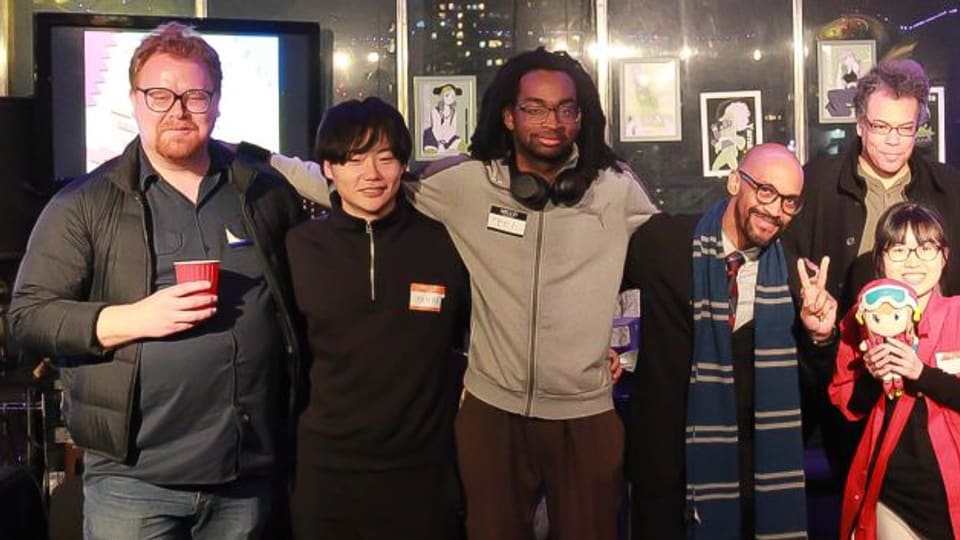
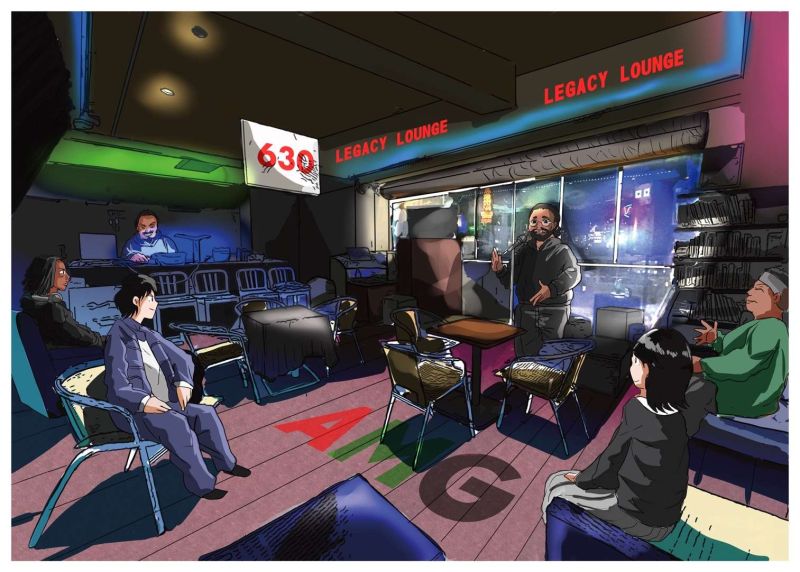
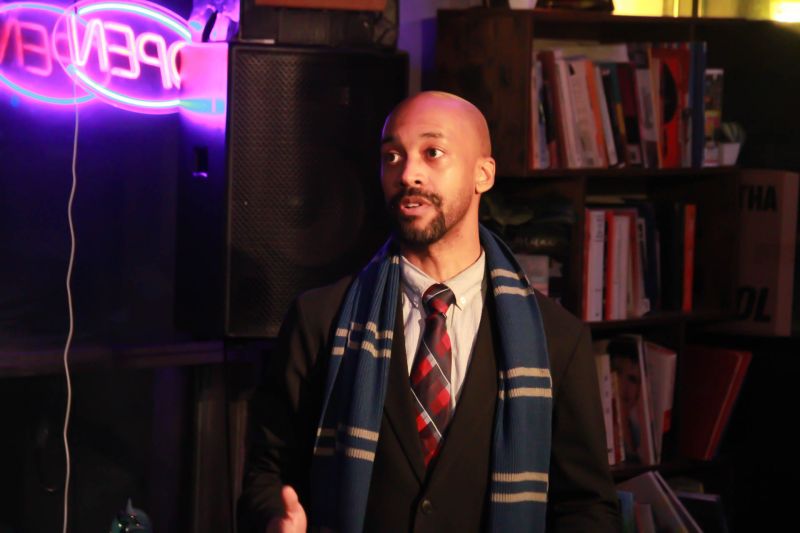
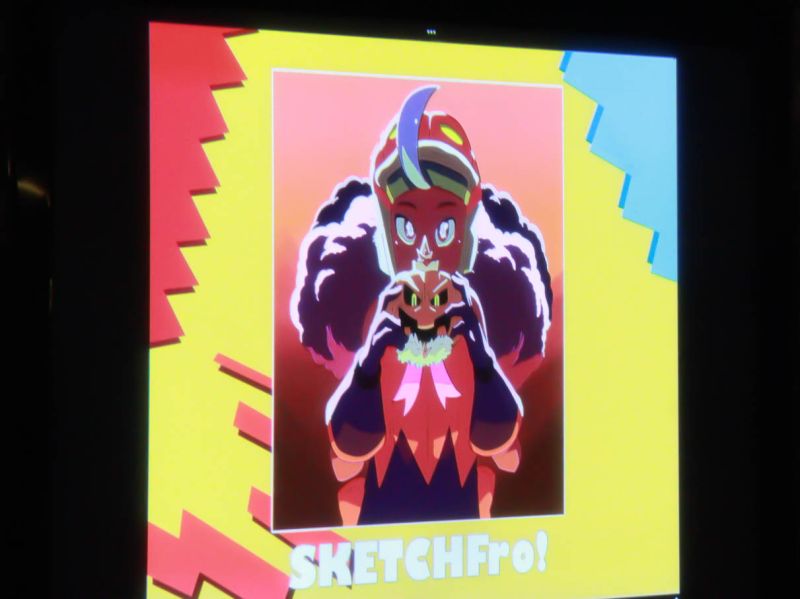
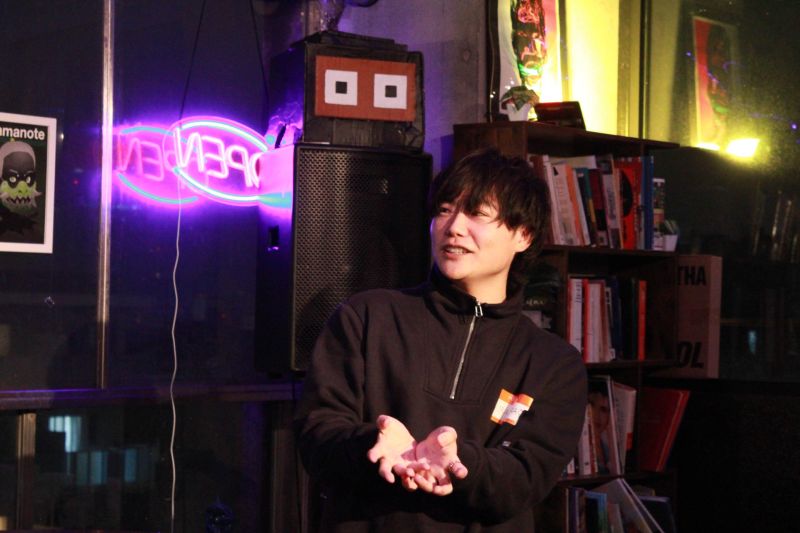
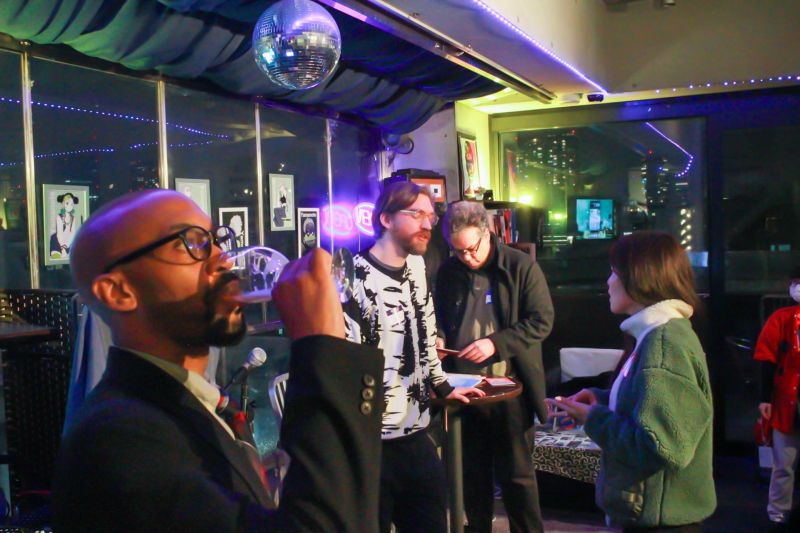
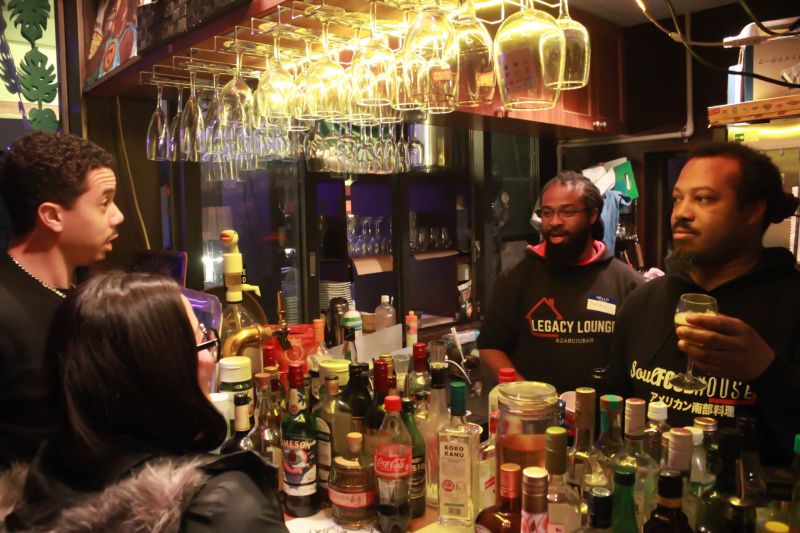
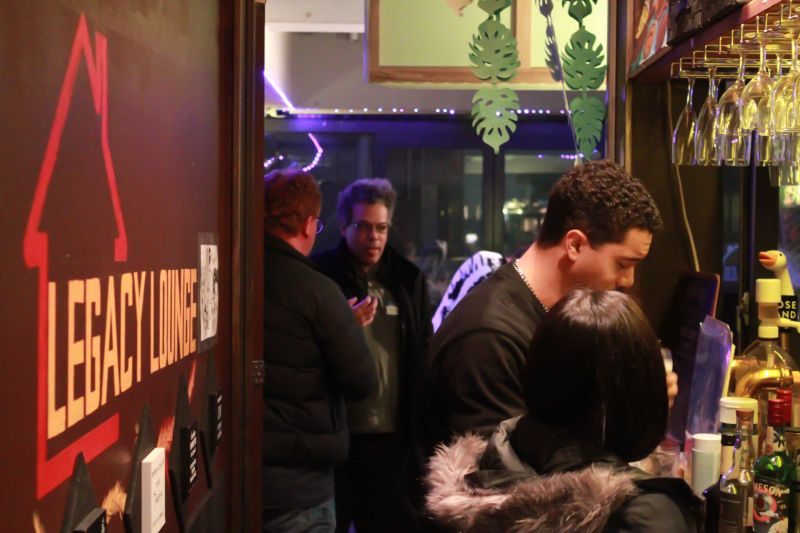
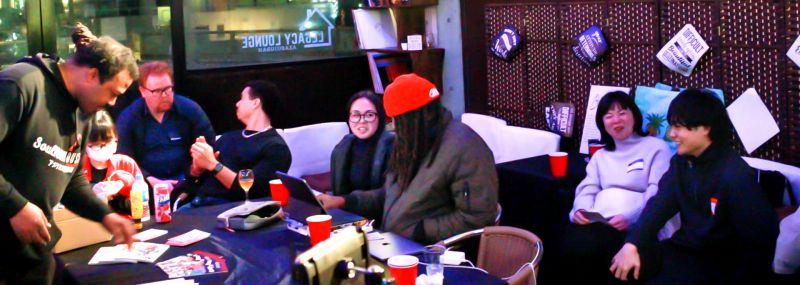
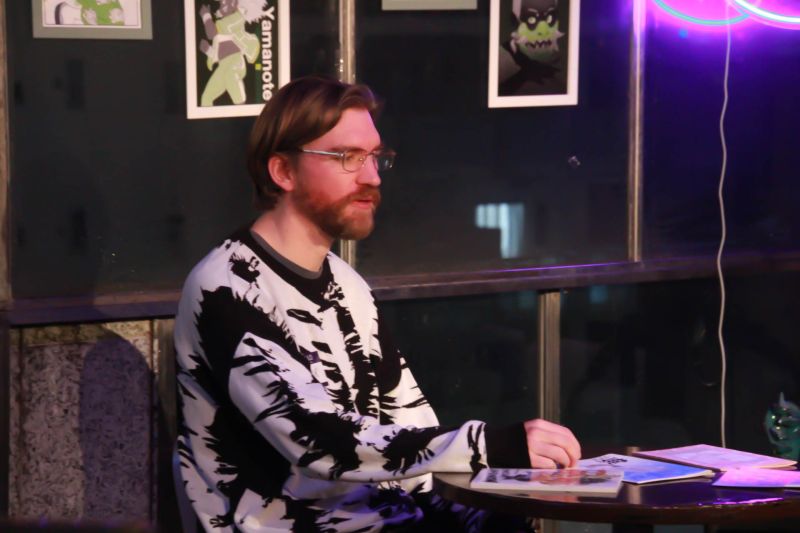
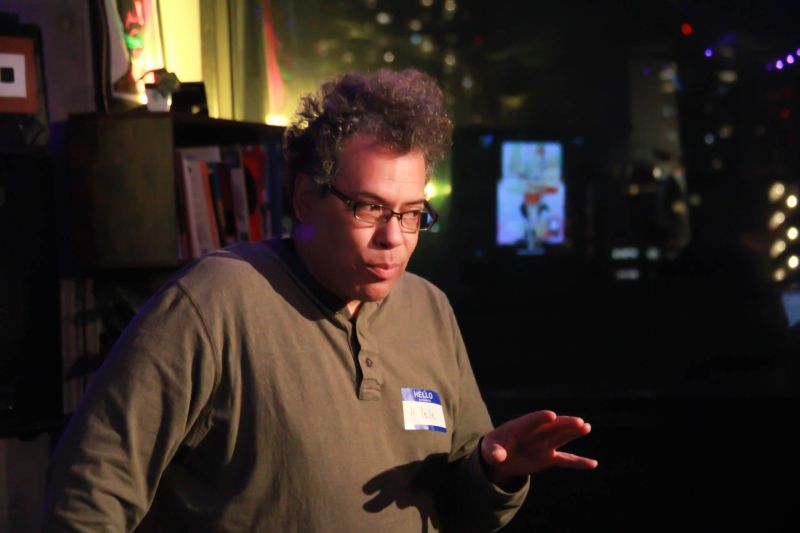
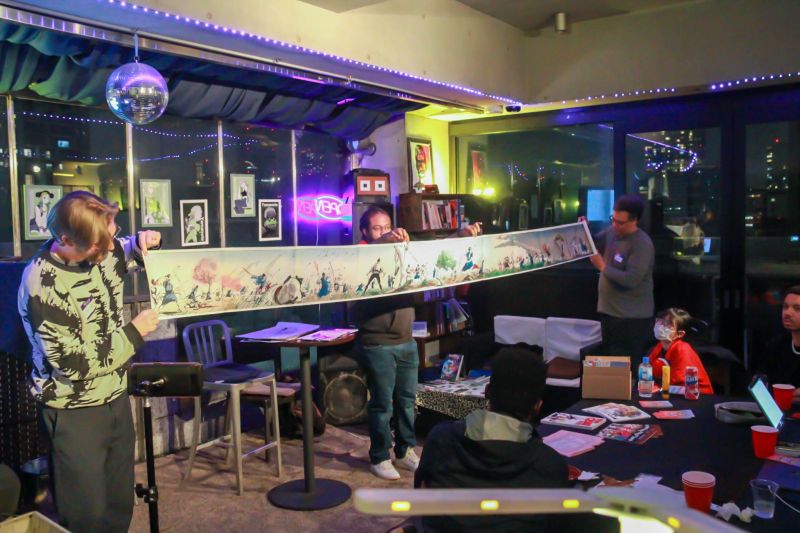
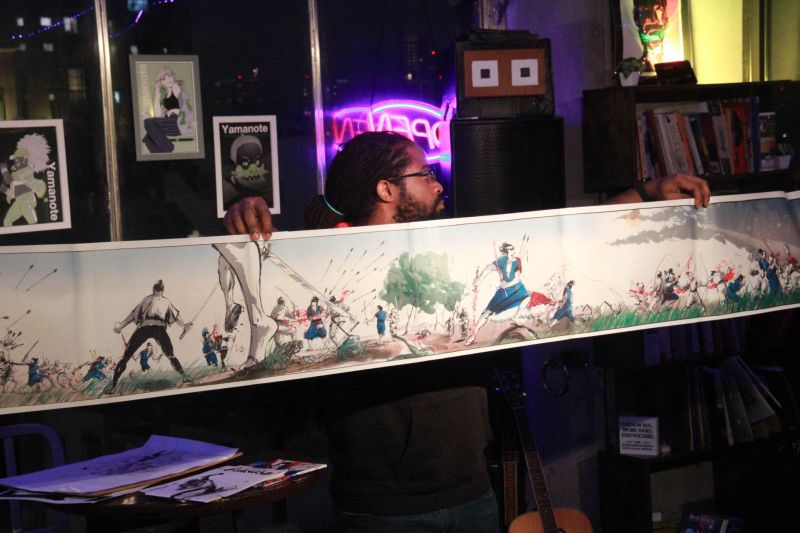
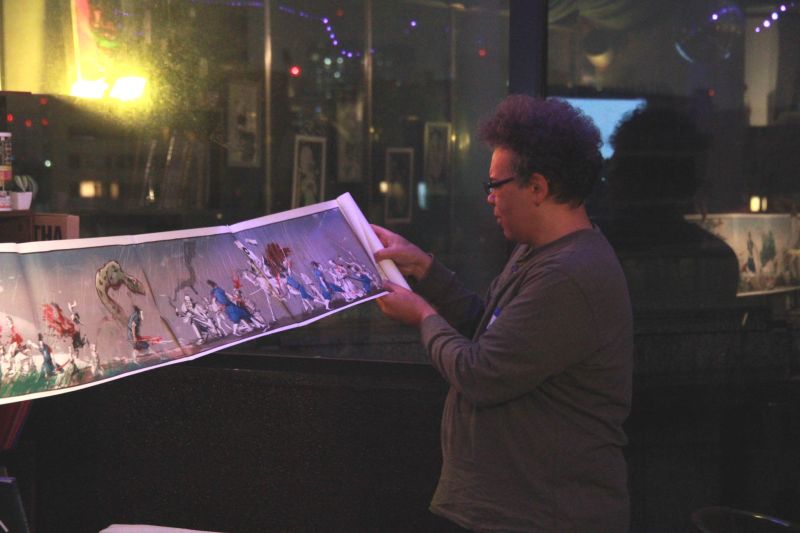
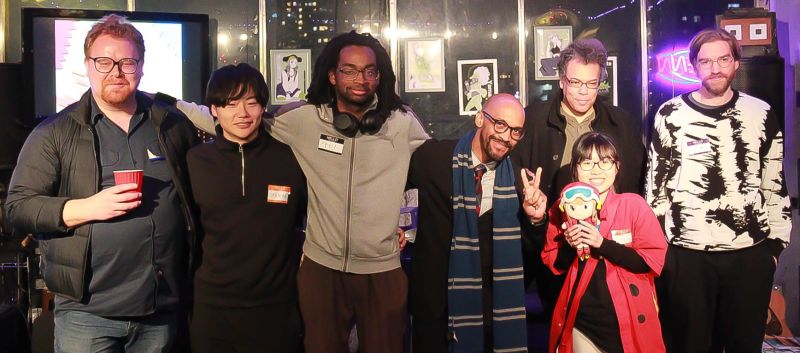
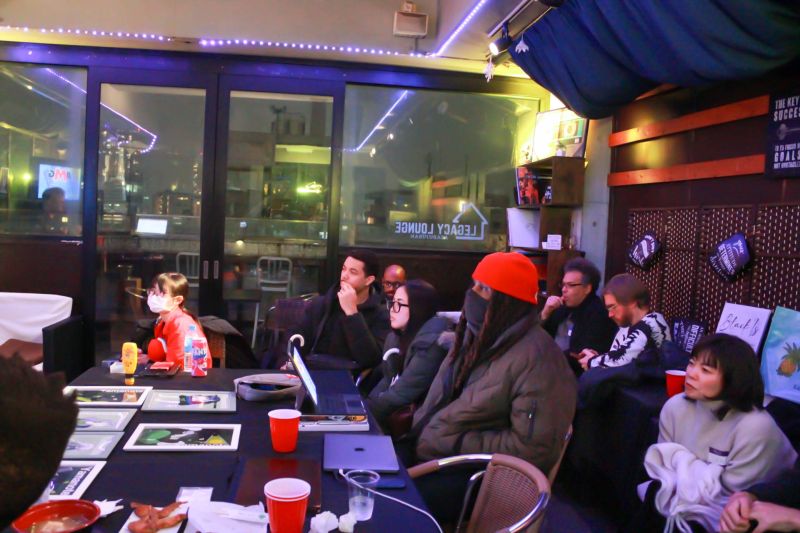
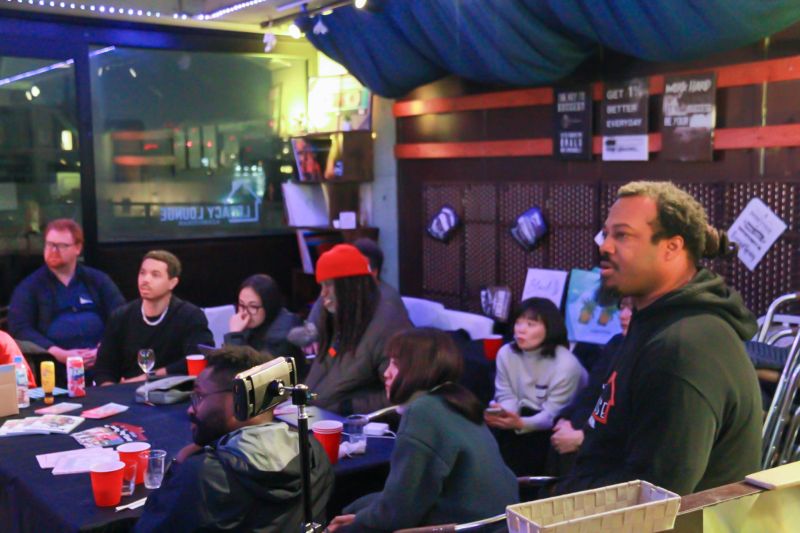
These photographs document AMG=N³'s first official event at Legacy Lounge: an evening of presentations, artwork, research, food, conversation, and cross-cultural connection. The archive follows the event through Akihito's later LinkedIn field notes.
The identity artwork framed AMG=N³ as a space for creating together, exchanging experiences, sharing meals and music, presenting research, and connecting through anime, manga, and games.
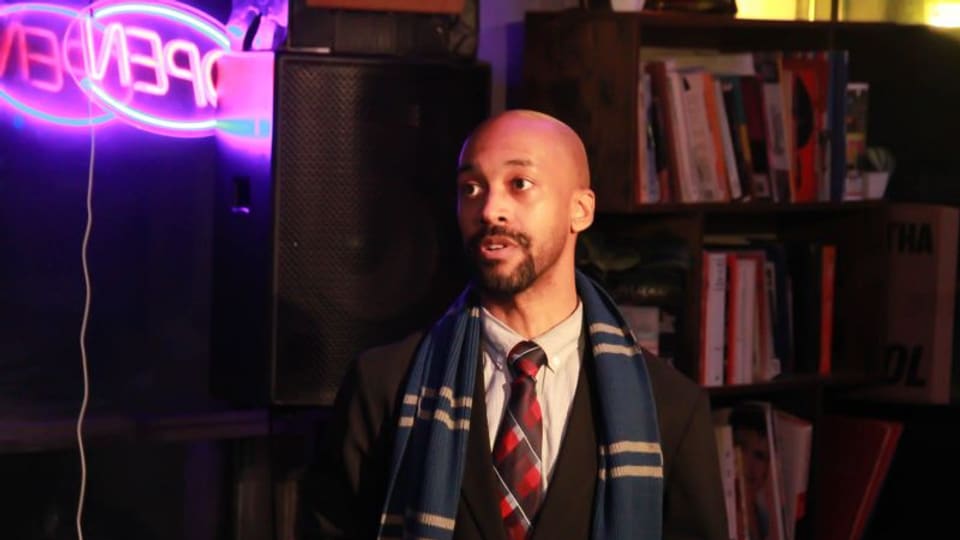
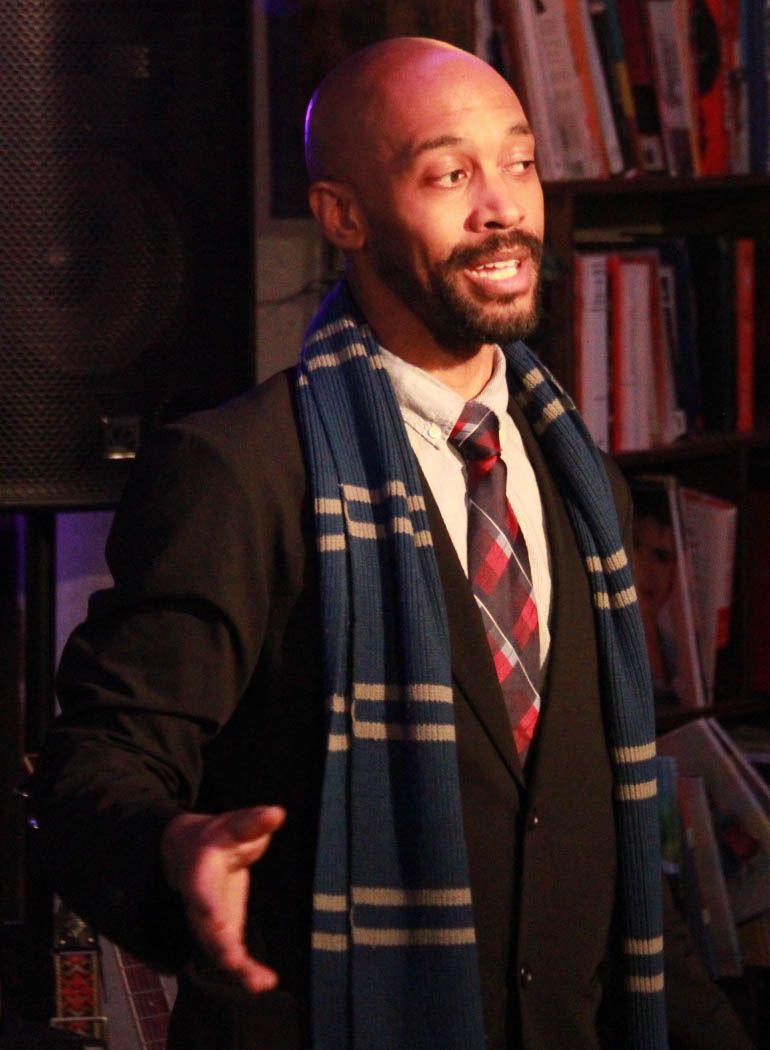
Co-Founder and Co-Host Christopher Richard Taylor opened the event by connecting intellectual curiosity, cultural exchange, social networking, storytelling, and the work of building a shared space.
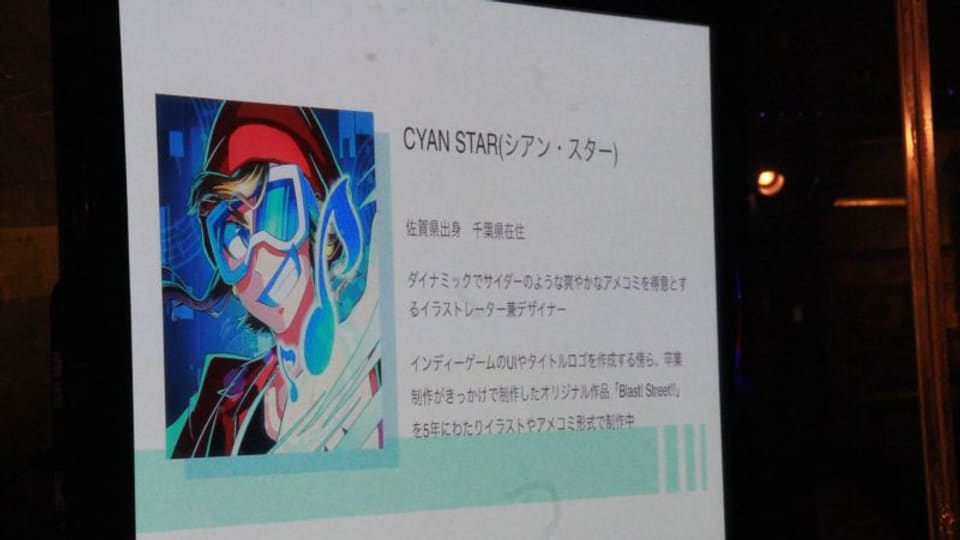
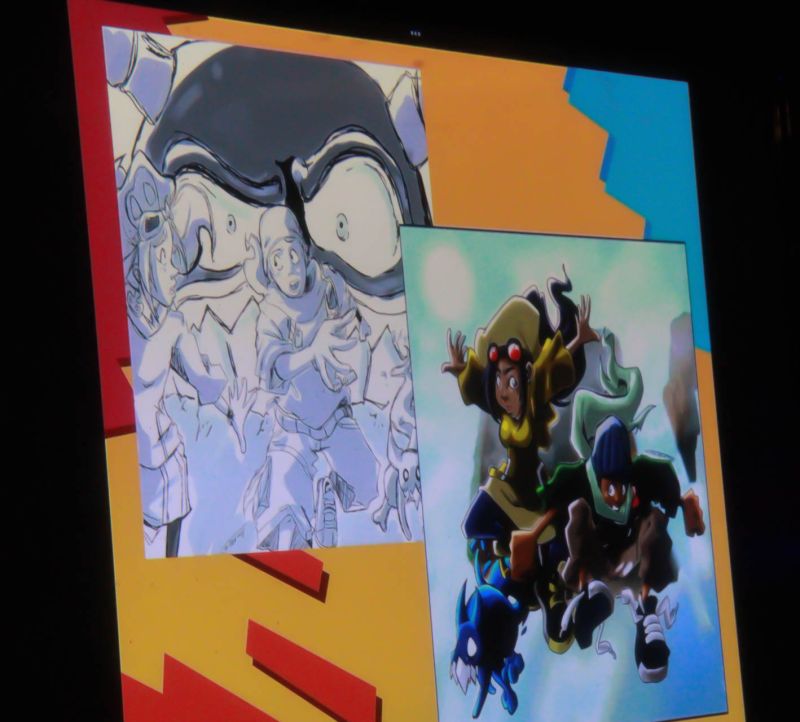
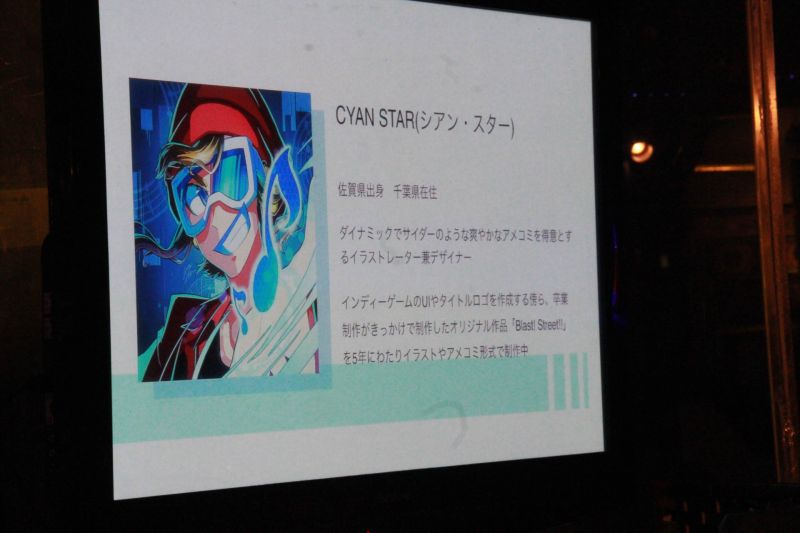
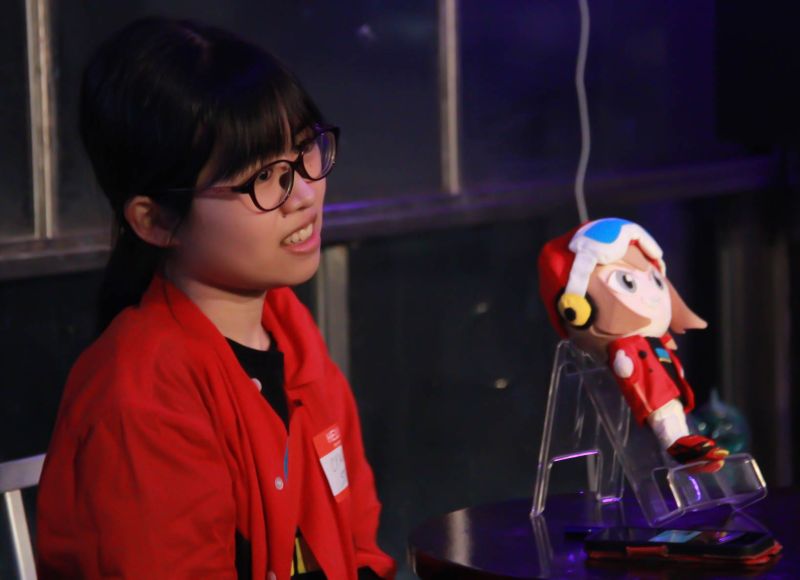
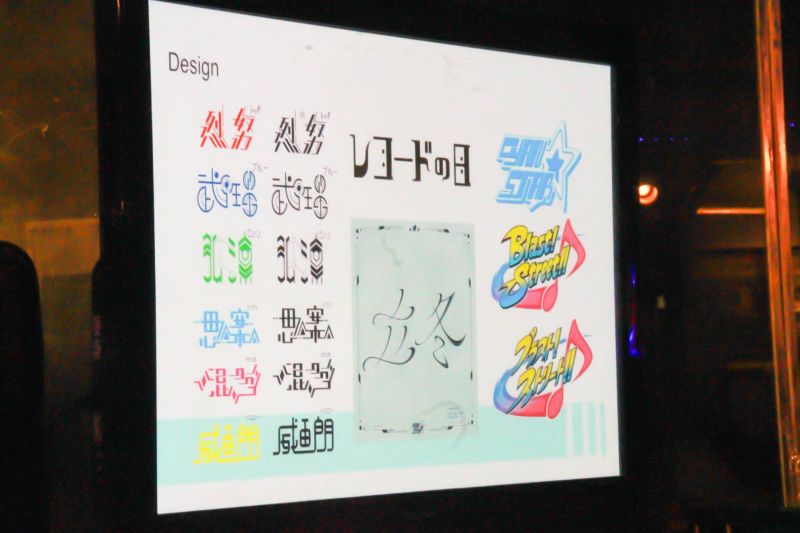
CYAN STAR presented a colorful, expressive approach to character, logo, and game design through the independently developed Blast! Street! series and other design studies.
Professor Patrick W. Galbraith explored relationships among anime, manga, disability, and underrepresented communities, drawing from research as well as lived connections and experience.
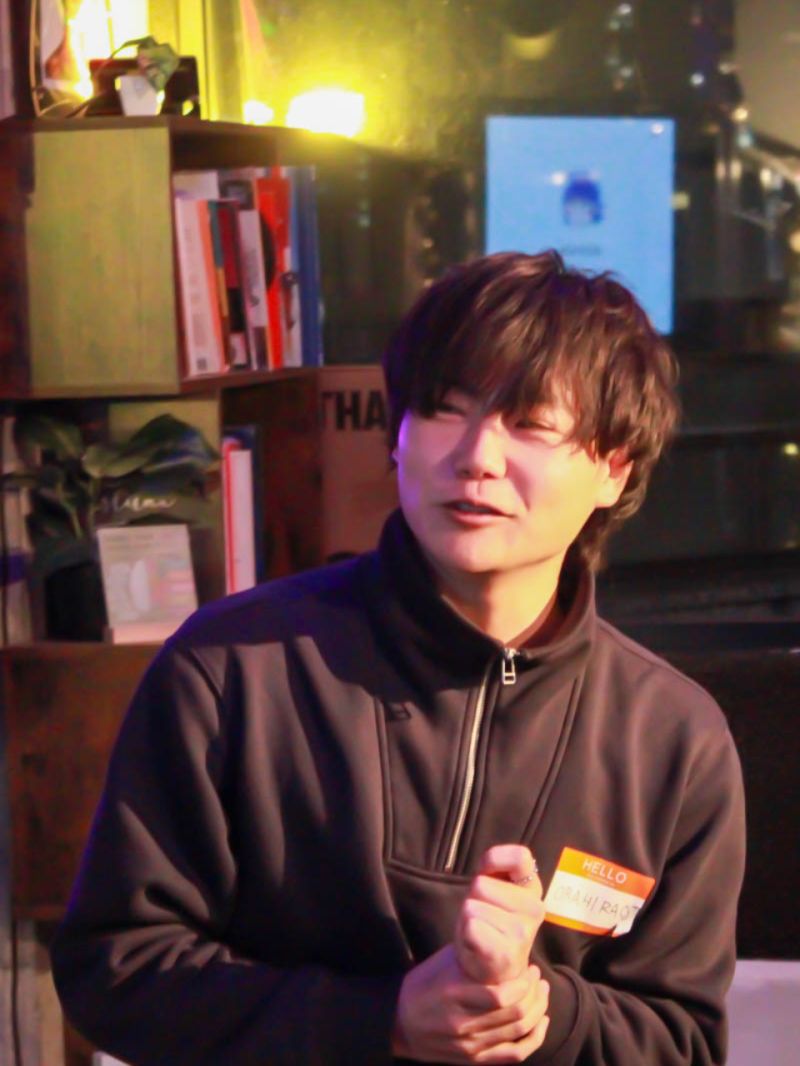
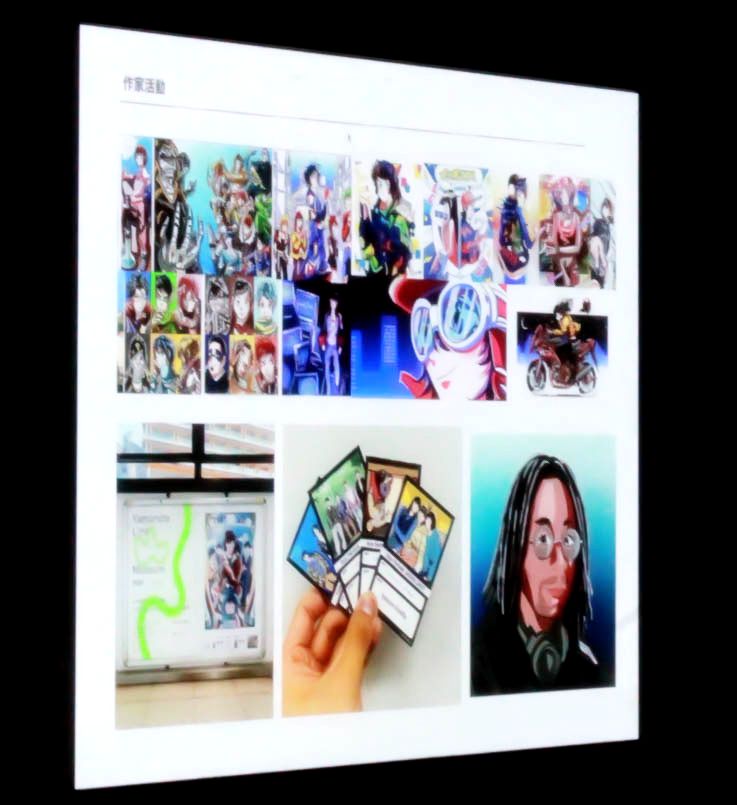
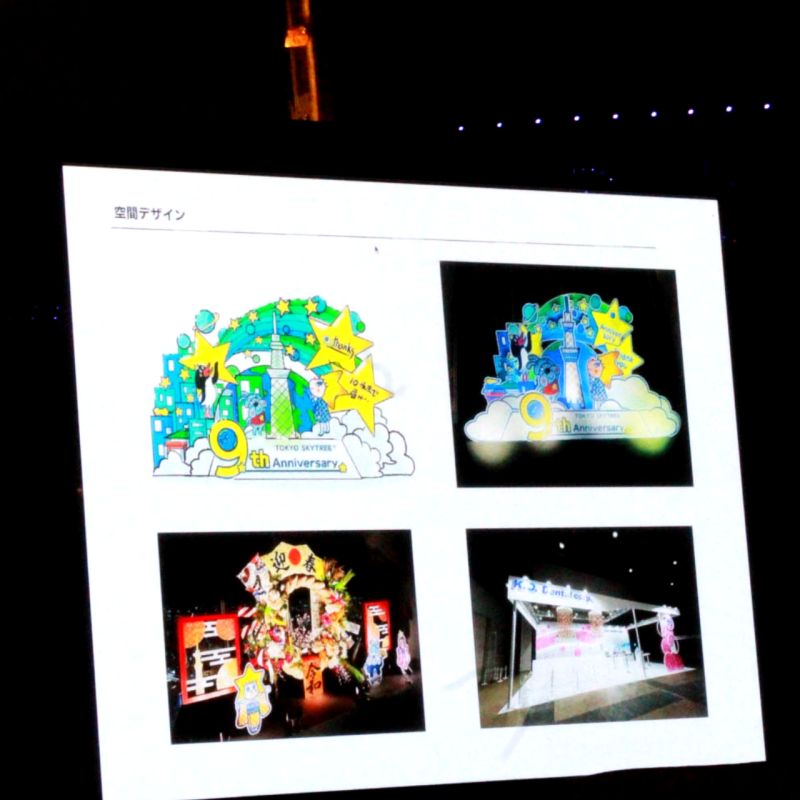
Orahirao-Sensei shared years of illustration, digital design, commission, exhibition, poster, advertising, and spatial-design work while discussing the craft behind a sustained creative career.
The intermission made room for drinks, informal conversation, new introductions, and the social connection at the center of the event's purpose.
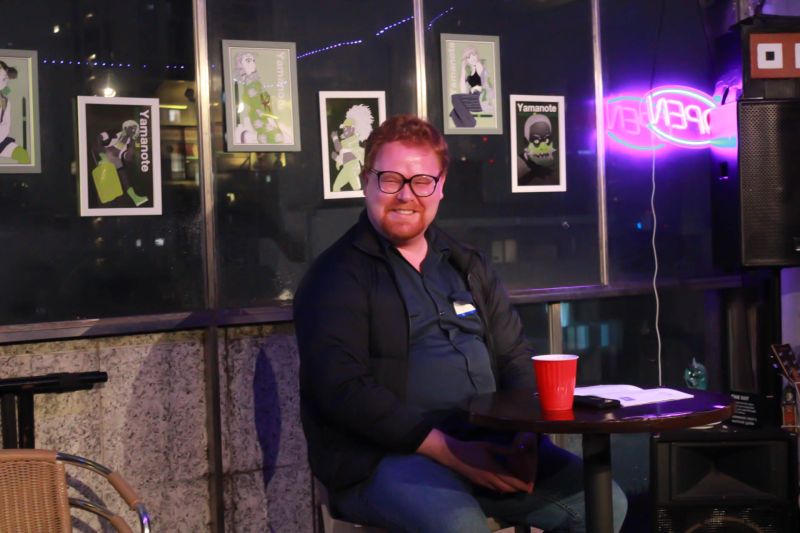
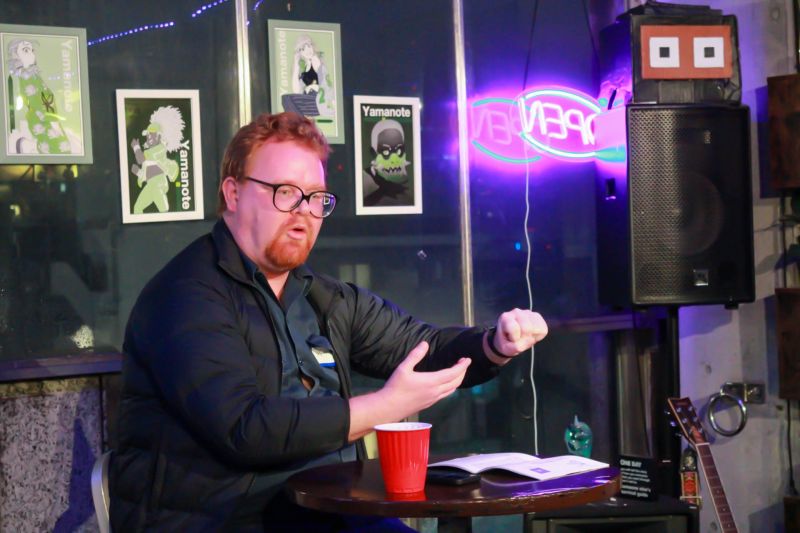
Oscar, creator and artist of BigFatDog Comics, discussed his career, creative process, and experience producing artwork in Japan.
Mule reflected on years of assistantships, professional work, collaboration, artistic development, and the challenge of building and sustaining a career in the industry.
The finale brought presenters, artists, researchers, organizers, and guests together after an evening designed around support, conversation, creative exposure, and the beginning of the AMG=N³ organization.
Archive credit: Event photography and field notes by Akihito Chiba. Identity artwork credited in the source post to Orahirao29. View the original AMG=N³ image posts on LinkedIn.
In June 2025, Akihito traveled to Kyoto for the Mechademia Conference on Asian Popular Cultures. Held from June 7 through June 9 at Kyoto Seika University and the Kyoto International Manga Museum, the gathering returned him to a living academic environment centered on anime, manga, games, fandom, and related media cultures. It was not a return to Waseda; it was evidence that the research path continued beyond the degree.
Game planning offered another way to make ideas tangible. Akihito was drawn to games in which mechanics, abilities, characters, creatures, environments, and action carry the narrative rather than merely sit beside it. The direction extended the same question behind his thesis: how can entertainment connect with people, communicate ideas, and teach through experience?
Akihito moved out of his homestay family's home around June 1. The departure was difficult but natural—the end of a stage, not the end of the relationship. He remained close to the family and the wider network that had supported him.
This period closes without a clean answer. Akihito enters game planning and a home of his own still wondering whether his younger siblings truly see him as a brother, whether he was a good one, and whether he can accept forgiveness already offered. The three questions remain alive: a good life, strength, and a good person—not conclusions reached, but directions carried into the next adventure.
FULL CHAPTER // FIRST DRAFT
The planner-preparation period becomes a lived route here. Akihito formally entered Human Academy's two-year Game College planning course around mid-to-late April 2025, carrying forward the research questions, community responsibilities, and creative interests developed before enrollment. This chapter follows the surviving record through August 21, 2026. It remains ongoing as the course, projects, and professional direction continue to develop.
Human Academy did not replace Akihito's earlier work; it gave that work another production language. Questions about culture, interpretation, identity, learning, and connection now had to become rules, systems, player choices, specifications, schedules, and experiences that a team could actually build.
An early Game Jam became less a record of a finished project than a lesson in leadership, supervision, opportunity cost, and adaptation. Akihito entered expecting meaningful planning practice. As the team settled into a structure centered on instructions from one controlling point, he found that he was neither contributing substantially nor developing the skills he had joined to practice.
Rather than compete for control or remain only to occupy a place on the team, Akihito stepped back. The decision was not framed as quitting at the first difficulty. It was a planning decision: reassess the original objective, measure whether the current route still serves it, and redirect limited time when the answer changes.
In a later Team Production class, Akihito expected to support or shadow a more experienced planner. Instead, he was placed in a leadership position within a planning group made entirely of first-year students and asked to help direct a larger programming group. He accepted the responsibility, while recognizing the difference between leadership potential and production experience.
The challenge was structural as much as personal. A team can possess strong programming capacity and still lose time if planning cannot stay ahead of implementation. Concepts must become decisions; decisions must become specifications; specifications must be communicated clearly enough that programmers and artists can work without repeated uncertainty or avoidable rework.
The leadership model developing here balances three views at once: what serves the game, what serves the team and its members, and what allows Akihito to grow responsibly. Those answers can overlap, but leadership requires noticing when they do not.
Course discussion and later reflection sharpened Akihito's understanding of how responsibilities overlap inside game development. Job titles do not form perfectly sealed boxes, especially in Japanese studios. The useful distinction is each role's center of gravity and the adjacent work it must understand.
For Akihito, the conclusion is not that every planner must perform every job. It is that a planner cannot ignore the work around planning. Decisions create consequences across disciplines, and long-term growth toward lead planning or direction requires understanding those consequences well enough to coordinate people, protect the game's intent, and revise responsibly.
The course period also pushed Akihito to treat ideas as records that other people can inspect. Concepts, visual sheets, prototypes, design reasoning, development status, and specifications became parts of the same professional archive. Smoothie Slicer and Grow-Me Garden show playable but unfinished work; Sushi Samurai, Rebirth of Retro, StyleBound, and Cocktail Crafter preserve other stages of concept and presentation development. Their value is not that every project is release-ready. Their value is that each exposes what has been imagined, clarified, built, tested, or still needs work.
OPEN DEVELOPMENT ARCHIVE Loadout Bay Concepts, prototypes, presentation sheets, documentation, and current completion recordsThe Human Academy chapter is not a victory summary written after everything is finished. It records Akihito while he is still learning how to convert ideas into production, how to lead without reducing leadership to control, how to respect other people's time, and how to adapt without abandoning the larger direction.
ONGOING CHAPTER // LAST UPDATED AUGUST 29, 2026 // SOURCE RECORD THROUGH AUGUST 21, 2026
Double major in Asian Societies, Cultures, and Languages and African and African American Studies at Dartmouth College.
Completed through the Graduate School of Asia-Pacific Studies at Waseda University in September 2024.
Ten weeks of intermediate Japanese language study, cultural coursework, and homestay immersion at Kanda University of International Studies.
Coursework and community-based learning through Dartmouth and the University of Ghana, Legon.
Legal assistant work in Accra spanning Ghanaian legal research, client consultations, interviews, and lawyer support.
A team-built resource database for Black businesses and projects, plus an individual youth proposal centered on anime, manga, and games.
A Dartmouth award received during graduate study at Waseda University.
Current enrollment in the two-year Game College planning course, Planner Department/Focus.
An Analysis of Two Communities' Relationship with One Form of Entertainment
This shelf unifies the creator-provided graduate documents with the research dossier already preserved on Gamers' Grind. The two public files are English-language archive editions; the surrounding interface changes with the site's English/Japanese setting.
The complete master's thesis, including the research basis, literature review, methodology, quantitative and qualitative findings, discussion, conclusion, and bibliography.
A concise overview of the research problem, comparison between the two communities, analytical foundation, and planned contribution.
This graduate research examined how Black American and Japanese audiences received and interpreted anime and manga, with particular attention to shounen works and the interconnected franchises participants watched and read. It compared shared and differing themes, meanings, and forms of identification while asking how popular culture might support communication across different social and cultural histories.
The concepts below are attributed to their original scholars. They are foundations used by Akihito's research, not theories or frameworks claimed as his own.
Cultures and Societies in a Changing World, 4th ed., SAGE Publications, 2012. Griswold's Cultural Diamond connects creators, cultural objects, receivers, and social worlds. The thesis accurately treats it as an analytical visual showing relationships—not as a strict causal model or complete theory.
Anime's Identity: Performativity and Form beyond Japan, University of Minnesota Press, 2021. Suan's work informed the discussion of anime operating across borders, shifting contexts, and differing communities of taste and interpretation.
Anime from Akira to Howl's Moving Castle: Experiencing Contemporary Japanese Animation, 2nd revised ed., St. Martin's Griffin, 2016. Napier's analysis supported the examination of darker, disruptive, celebratory, mournful, and psychologically complex themes within anime.
The Soul of Anime: Collaborative Creativity and Japan's Media Success Story, Duke University Press, 2013. Condry's work informed the treatment of anime as cultural production whose meanings and value emerge through creators, audiences, industries, and transnational communities.
“What Boys Will Be: A Study of Shōnen Manga,” in Manga: An Anthology of Global and Cultural Perspectives, 2010, pp. 62-76. Her work supported the contrast between heroes whose growth forms the narrative and heroes introduced after their status is already established.
The Anime Boom in the United States: Lessons for Global Creative Industries, Harvard University Asia Center, 2017. Their research contributed historical and industrial context for anime's expansion and reception in the United States.
A Disability of the Soul: An Ethnography of Schizophrenia and Mental Illness in Contemporary Japan, Cornell University Press, 2013. Nakamura's scholarship provided context where the thesis discussed mental health, social interpretation, and Japanese environments.
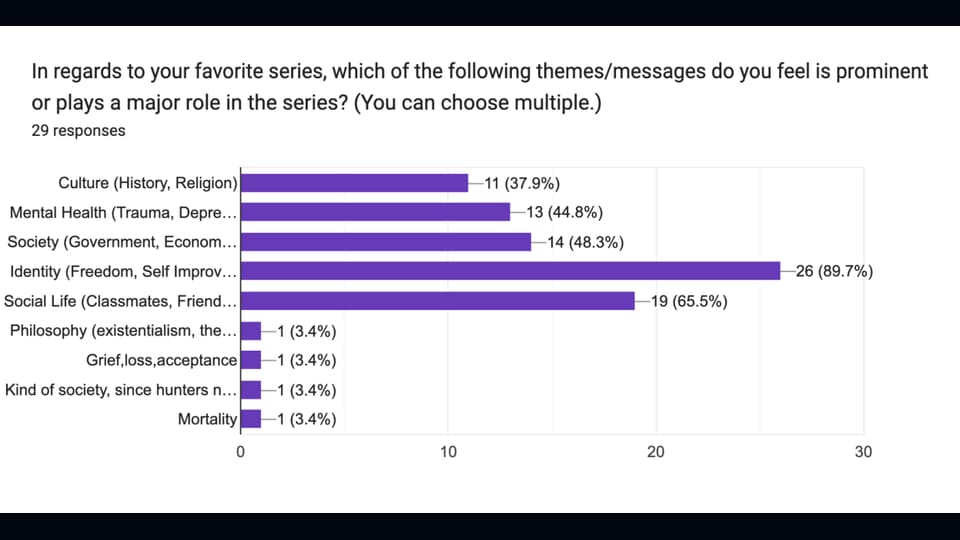
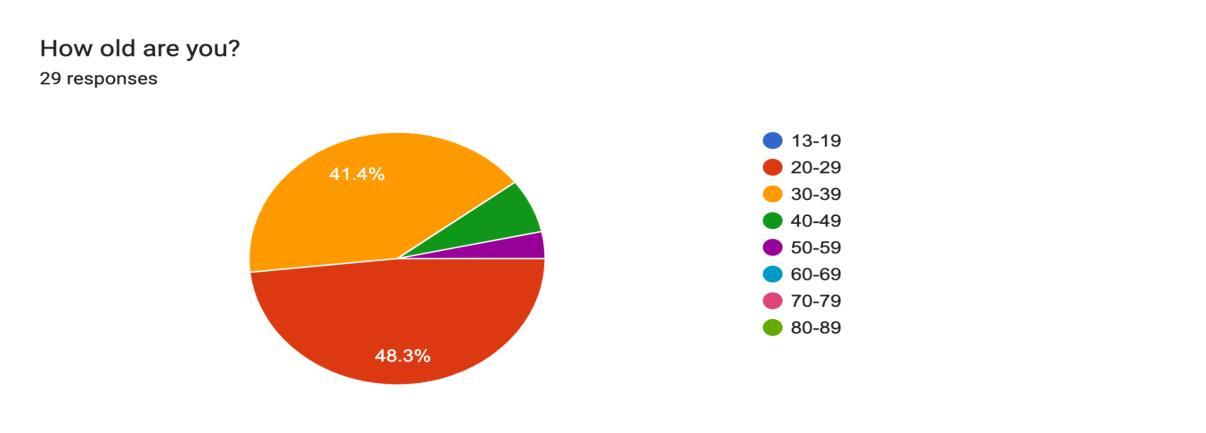
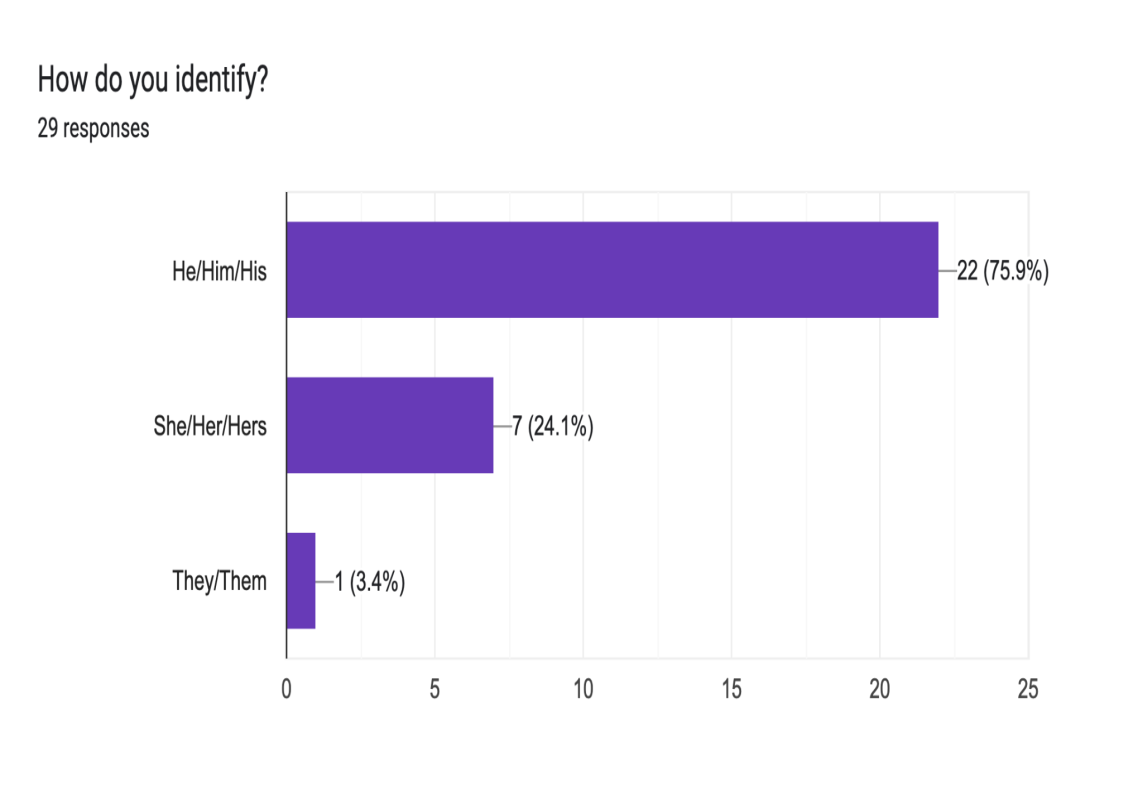
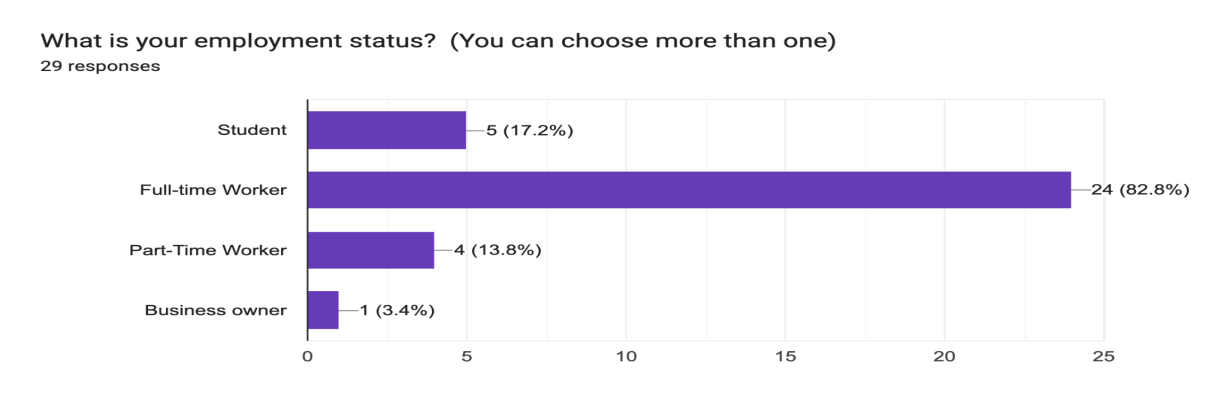
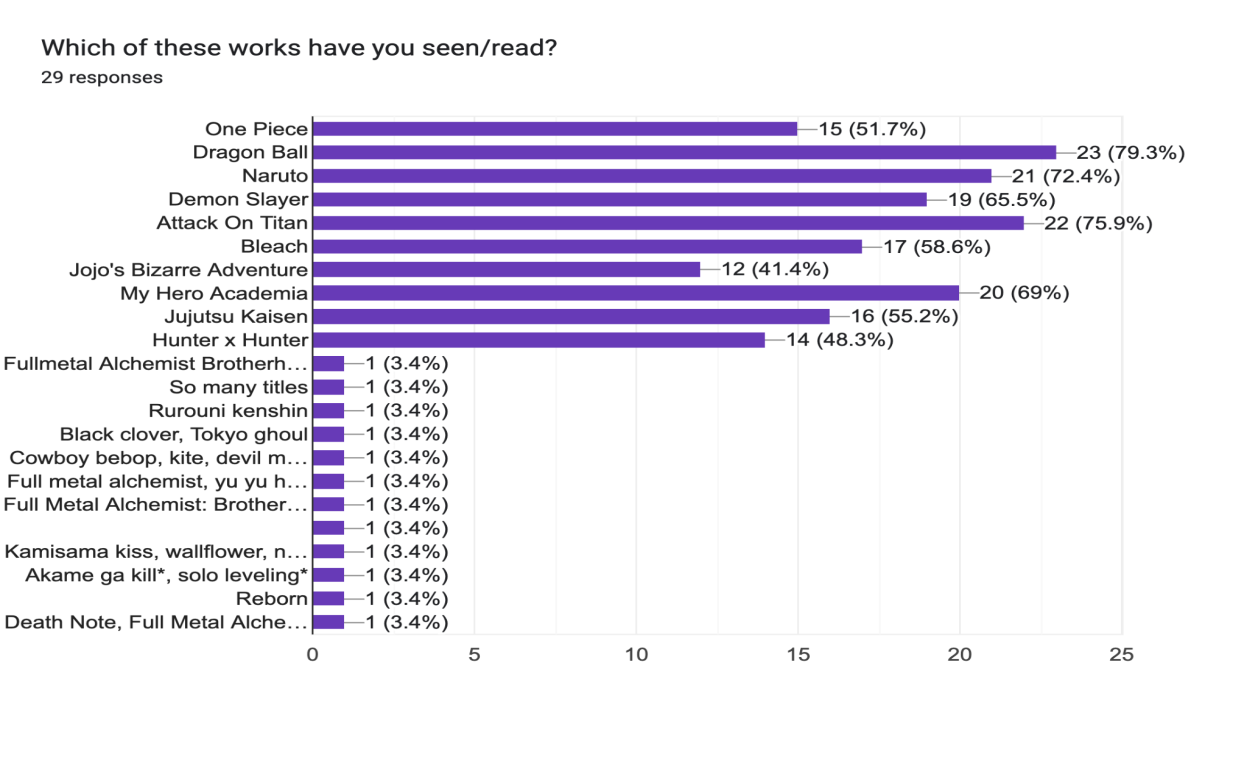
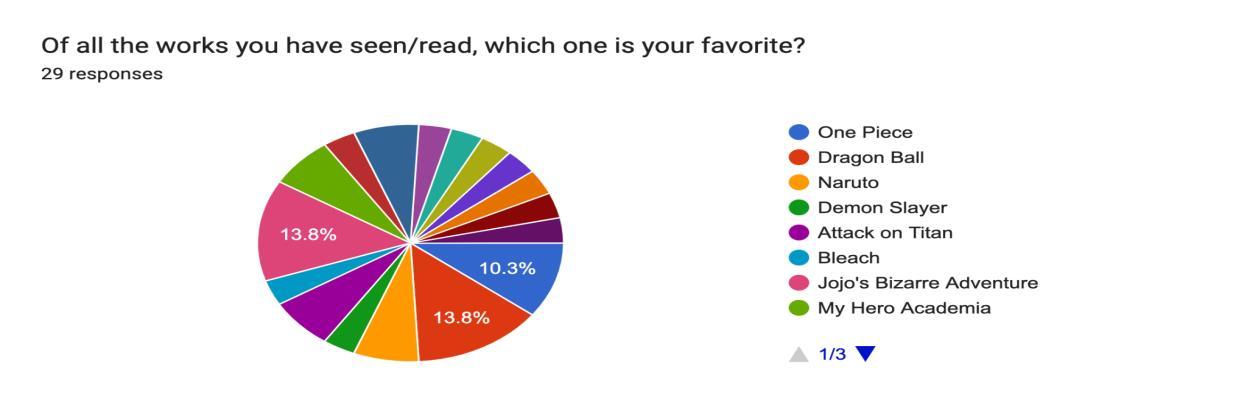
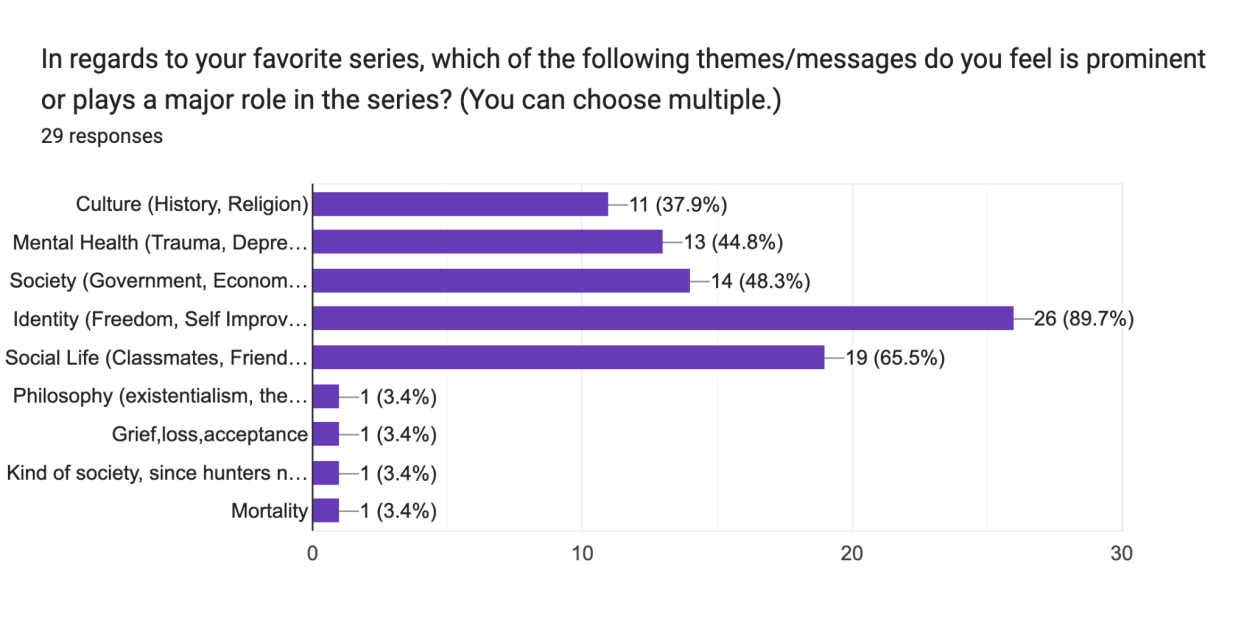
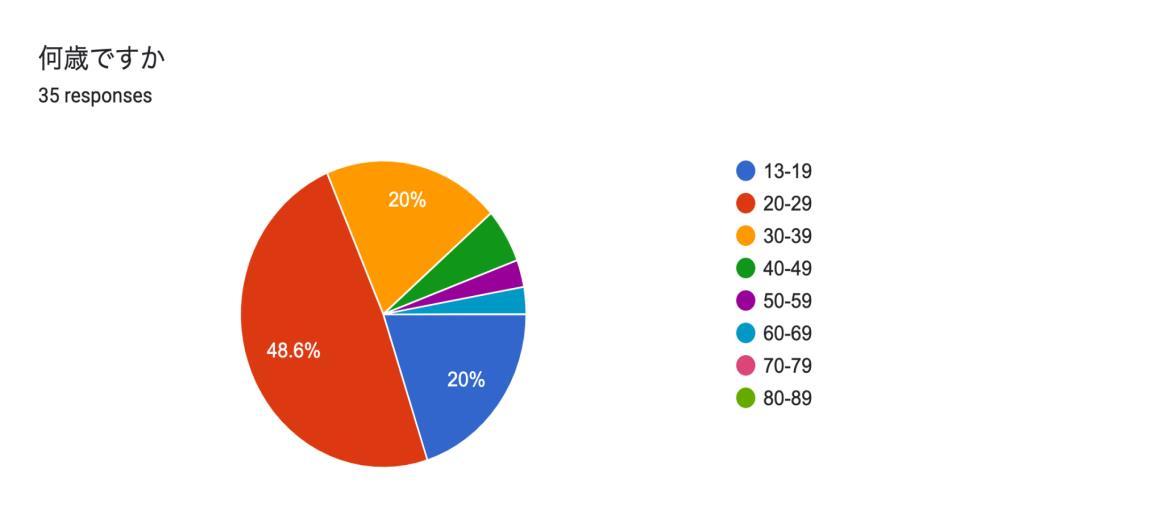
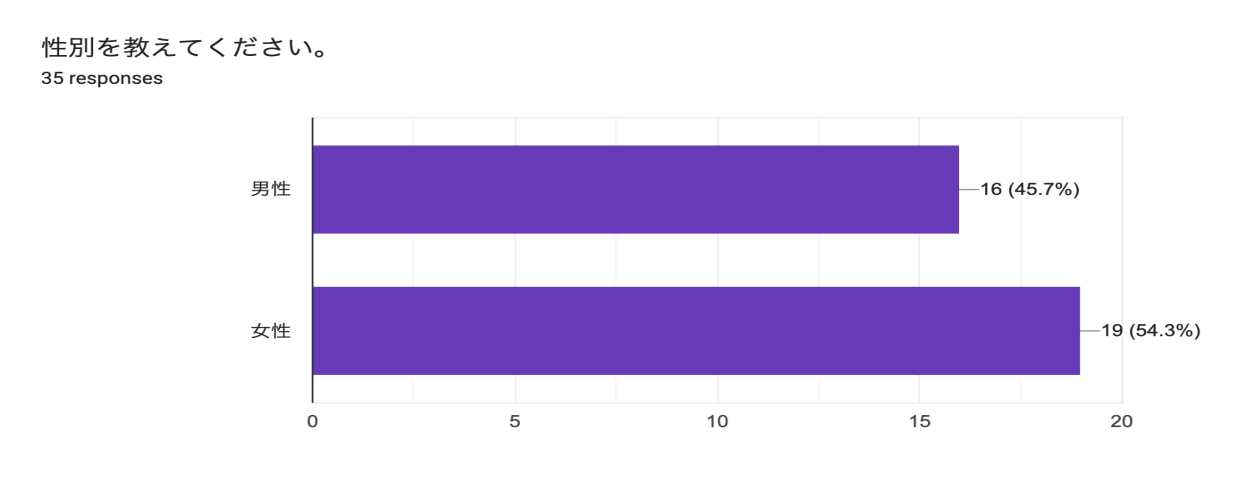
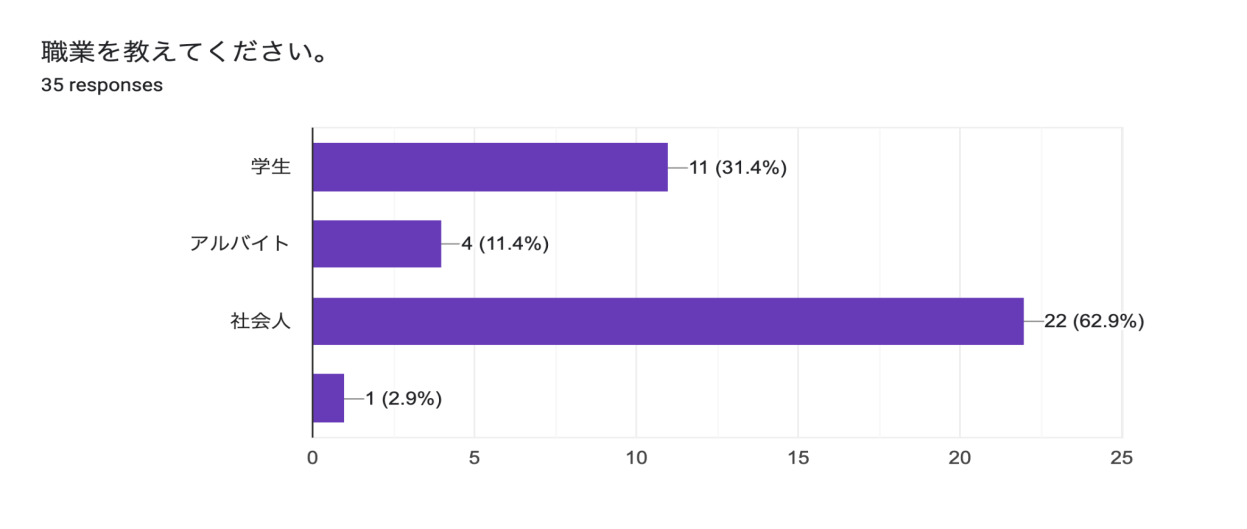
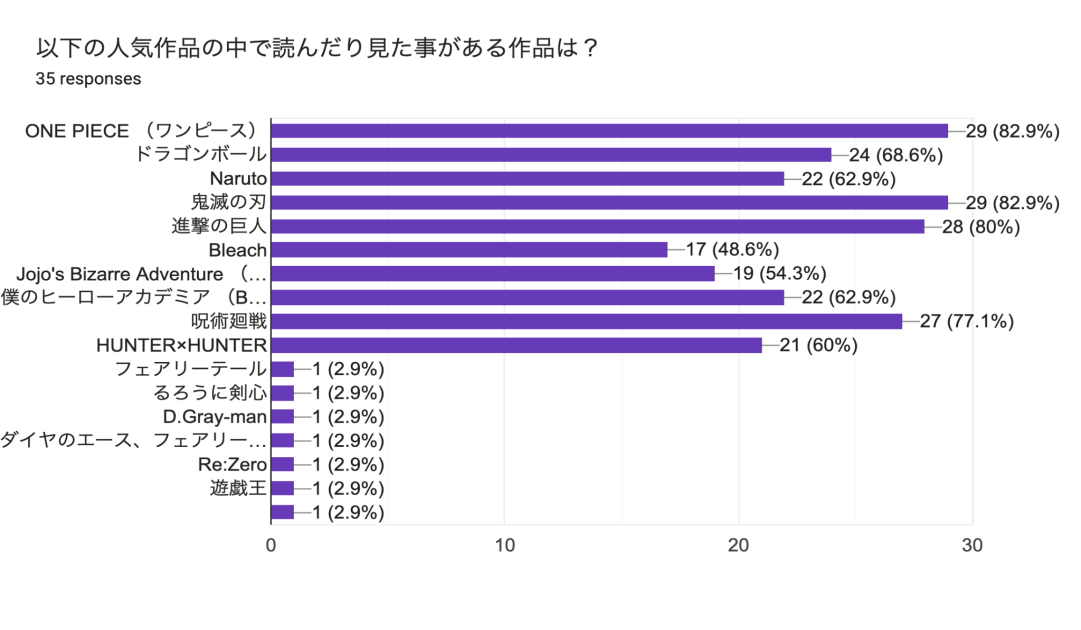
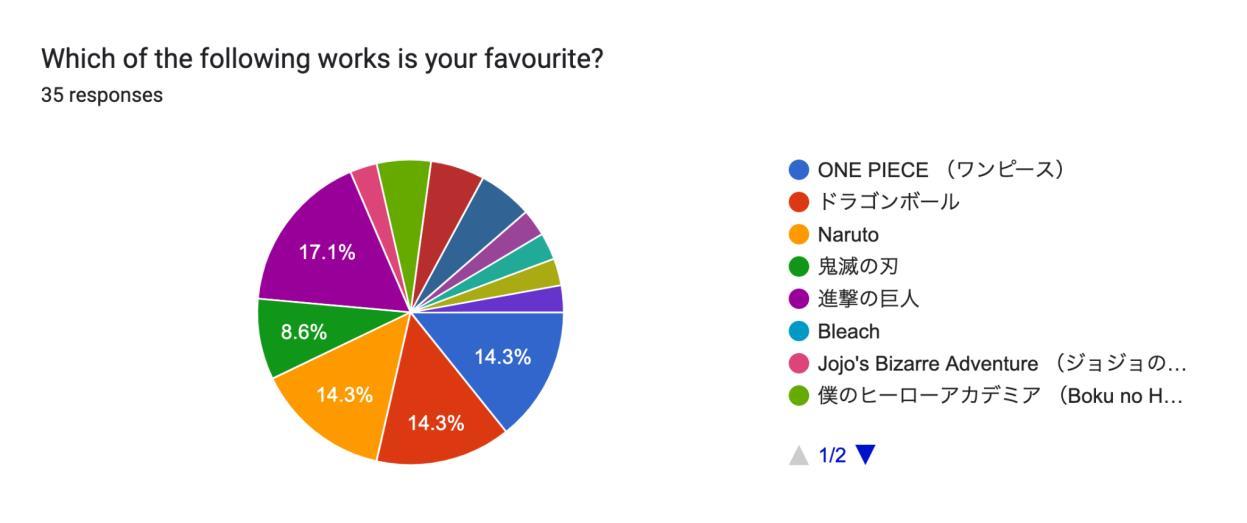
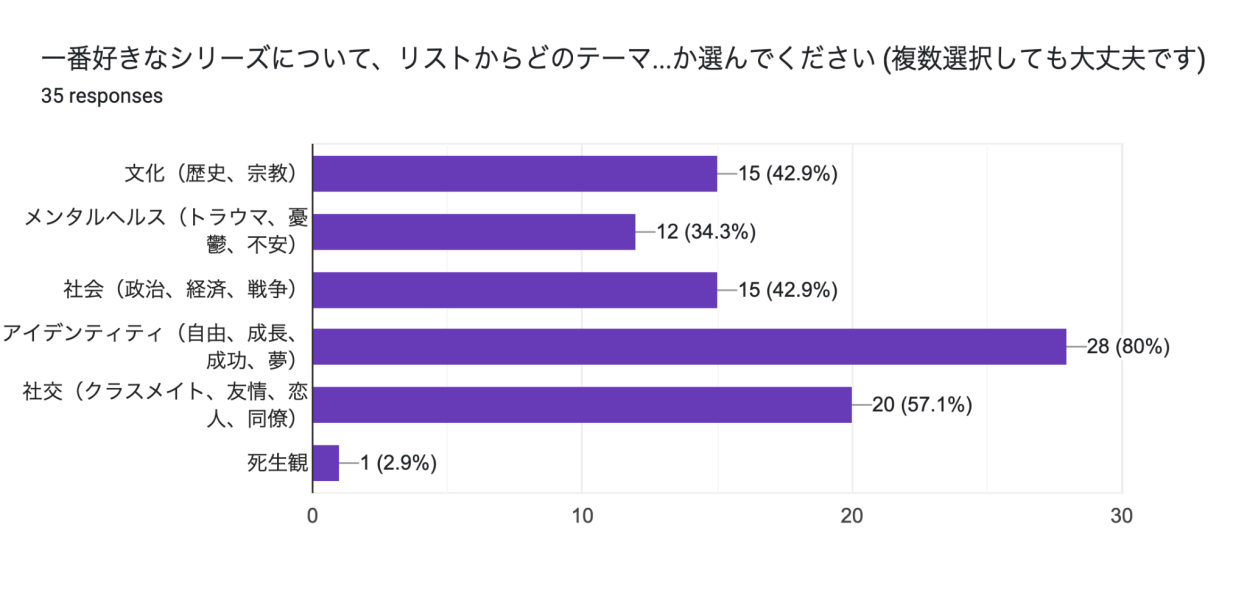
The thesis's twelve original questionnaire charts are preserved below. Select any chart to view the full-resolution visual.
Original questionnaire visuals from Akihito's graduate thesis. The works data includes anime watched and manga read.
Authorship and protected subject matter. The thesis text, survey instruments and original wording, charts, visualizations, original selection and arrangement of findings, systematic construction of the research dataset, analysis, interpretations, and conclusions displayed here are identified as Akihito's research and authorship. Copyright is asserted only to the extent that these elements constitute protected original expression, a protected compilation under United States law, or a protected compilation or database work under Japanese law.
Data boundary and participant protection. Individual facts, ideas, methods, media titles, cited theories, third-party scholarship, and underlying intellectual properties are not claimed as Akihito's creations. Public access is limited to aggregate results and selected visuals. It does not grant access to nonpublic participant-level data, personally identifying answers, or private interview records, and it grants no permission to attempt re-identification.
Permitted and prohibited uses. Lawful quotation and citation remain permitted to the extent provided by applicable law and should identify Akihito and the thesis. Except where applicable law provides otherwise, no permission is granted for reproduction, redistribution, republication, adaptation, translation, commercial exploitation, scraping, automated bulk collection, removal of rights information, circumvention of access controls, dataset reconstruction, or creation of derivative datasets without prior written permission.
Machine learning and information analysis. No express license or consent is granted for machine-learning or artificial-intelligence training, retrieval-augmented generation, embedding, text-and-data mining, or similar computational use. This reservation does not purport to eliminate any mandatory limitation or exception that applies under governing law, including uses that may qualify under United States law or Article 30-4 of the Japanese Copyright Act.
Third-party material and trademark status. All cited frameworks remain attributed to their original scholars, publishers, and rights holders. Anime, manga, game, character, and franchise names remain the property of their respective owners. BA³ + JA² is presented as the title of the thesis and research dossier, not as ownership of underlying facts or cited ideas and not as a registered trademark in the United States or Japan.
Notice version 1.0 // Effective August 14, 2026. Requests for reuse beyond the limited permission above may be directed to akihito.exe@gmail.com. No failure or delay in enforcing a right is intended as a waiver.
Independent journey // Lexicon interpretation
CLASSIFICATION RULE // A standard entry has one Primary Classification and may develop one less-dominant Secondary Classification. The secondary expands the entry's available expression but never equals the primary in proficiency or authority. Singularities exist outside this structure and carry no secondary classification.
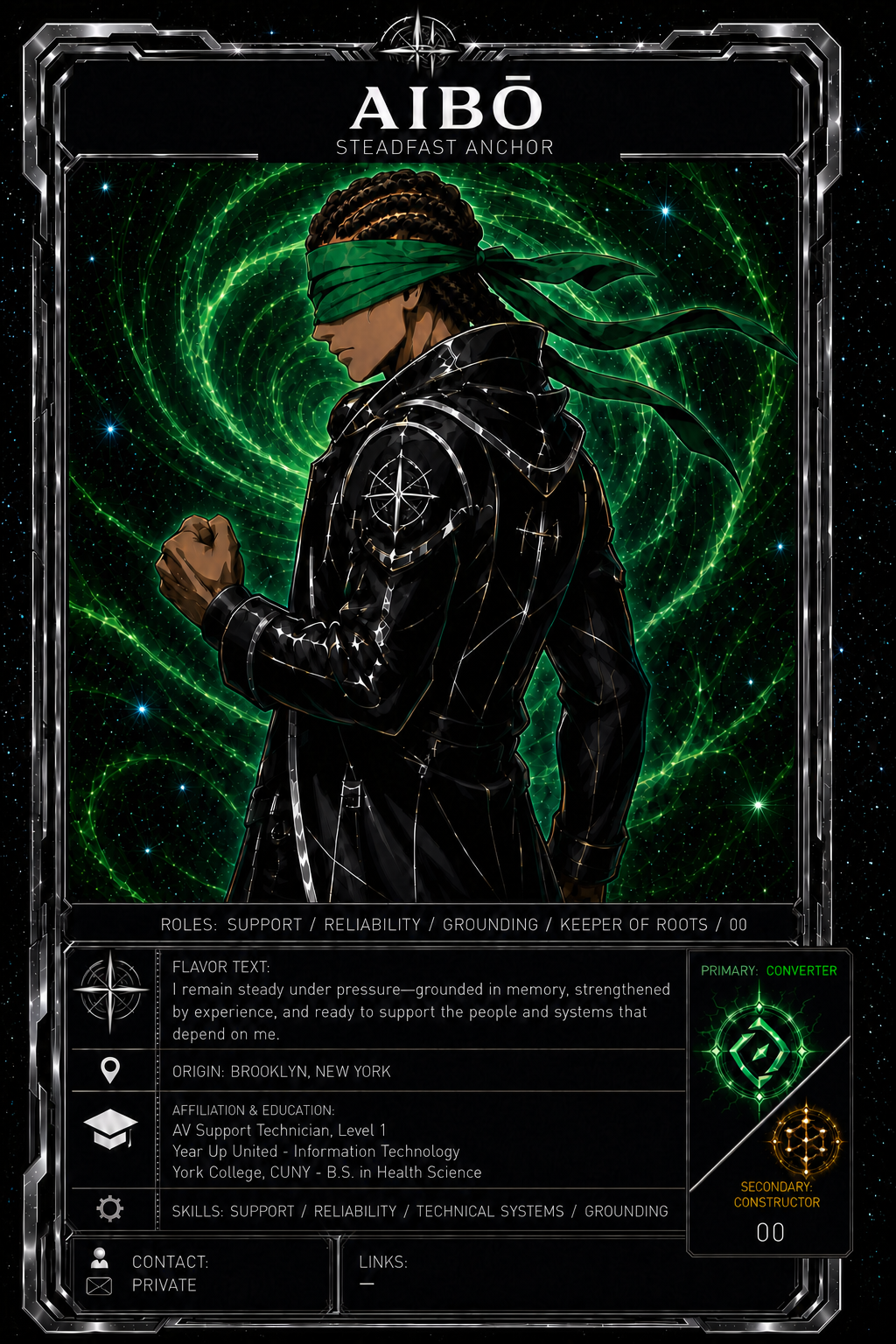
Aibō's journey moves from sustained study in Health Science into administrative responsibility, IT training, professional AV work, and an increasingly broad knowledge of technical systems.
At his core, Aibō is steady under pressure without becoming rigid: grounded in memory, strengthened by experience, and able to adapt as conditions change. Like water, he can shift course, take on new forms, and keep moving while preserving the values and history that anchor him. His story is about becoming dependable through flexibility, change, and a direction of his own.
Aibō's Primary Classification is Converter: he changes course and form without losing his center. His Secondary Classification is Constructor, giving him a less-dominant but meaningful affinity for stable foundations, dependable systems, and grounding. Converter remains his defining and strongest classification.
Aibō is Christian and occasionally sets aside time for prayerful meditation with God. He also has a strong love for anime and manga, enjoys music and cooking, and is a skilled violinist. Games are a lighter interest rather than a central part of his identity.
This chronicle is grounded in the supplied professional record. Private contact details are excluded, and the real journey is not presented as a literal explanation for Lexicon's fictional powers or events.
A long-term Bachelor of Science path in Health Science established a foundation in structured learning while the professional direction continued to evolve. The supplied record lists the program through August 2026.
Administrative work at a Brooklyn day care center combined scheduling, communication, and stakeholder coordination with regular technical troubleshooting. The role included managing as many as twenty monthly technical issues and coordinating resolutions with IT staff.
An Information Technology certificate program sharpened the transition into technical support. Coursework covered hardware, Microsoft Access, Excel, Outlook, project management, Jira, and the practices needed to diagnose and communicate technical problems.
During a Global Video internship at Blackstone, the work moved into conference-room readiness and live professional environments. Responsibilities included testing displays, AMX systems, Logitech Tap devices, iPads, microphones, audio equipment, video systems, software, connectivity, and related peripherals before important meetings.
Professional AV support at AllianceBernstein expanded the scale of responsibility to investor meetings, internal meetings, hybrid town halls, and events. The role centers on setup, testing, monitoring, hardware diagnostics, video switchers, Zoom, break/fix response, ServiceNow documentation, and maintaining room readiness.
CompTIA A+ certification formalized core IT support knowledge. Google Data Analytics and Google Cybersecurity certificates broadened the record beyond room systems and break/fix work into data, security, and the wider structures supporting dependable technology.
The real adventure is a progression toward readiness: learning the systems, supporting the room, documenting the problem, and becoming someone others can depend upon. Lexicon transforms that pattern into a story of resonance and partnership without claiming that the fiction is the whole person.
Résumé-grounded public facts with personal contact information omitted.
Conference-room readiness, investor and internal meetings, hybrid events, Zoom, video switchers, diagnostics, break/fix response, and ServiceNow workflows.
Conference-room AV checks and troubleshooting across displays, AMX systems, Logitech Tap devices, iPads, microphones, audio, video, software, and connectivity.
Scheduling, stakeholder communication, meeting coordination, and recurring technical-issue management.
Year Up United coursework in hardware, Microsoft Access, Excel, Outlook, project management, Jira, and technical support.
York College, City University of New York // listed from August 2018 through August 2026.
Information Technology certification recorded in February 2026.
Google Data Analytics Certificate and Google Cybersecurity Certificate.
Windows, macOS, Active Directory, ServiceNow, Jira, Zoom, AMX, Logitech Tap, iPads, Microsoft Office, hardware diagnostics, incident response, and hybrid-meeting systems.
Shared community memories will appear here after they are selected and approved.
CONNECTION BUILDS THE GRID.
Gamers' Grind is the gaming-focused platform of AMG=N³. This record preserves the community history that helped shape the wider network around the site.
Founded by Akihito Chiba, AMG=N³ connects people through anime, manga, games, research, art, food, conversation, and shared experience.
Confirmed community plans will appear here when a public route is ready.
Concepts, prototypes, design ideas, and active development updates.
Select a game to compare its starting idea with the build currently available on Gamer's Grind.
PROJECT RECORD // GG-GMG-01
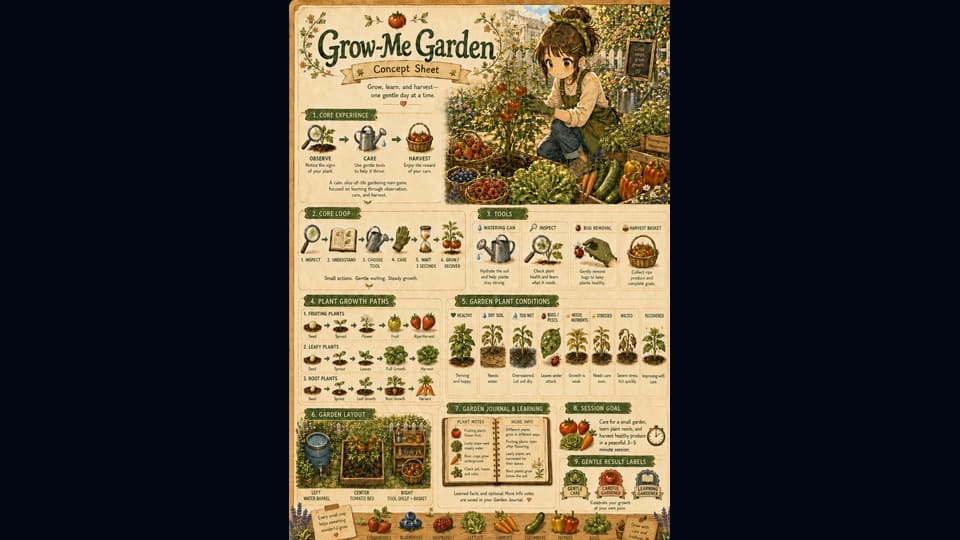
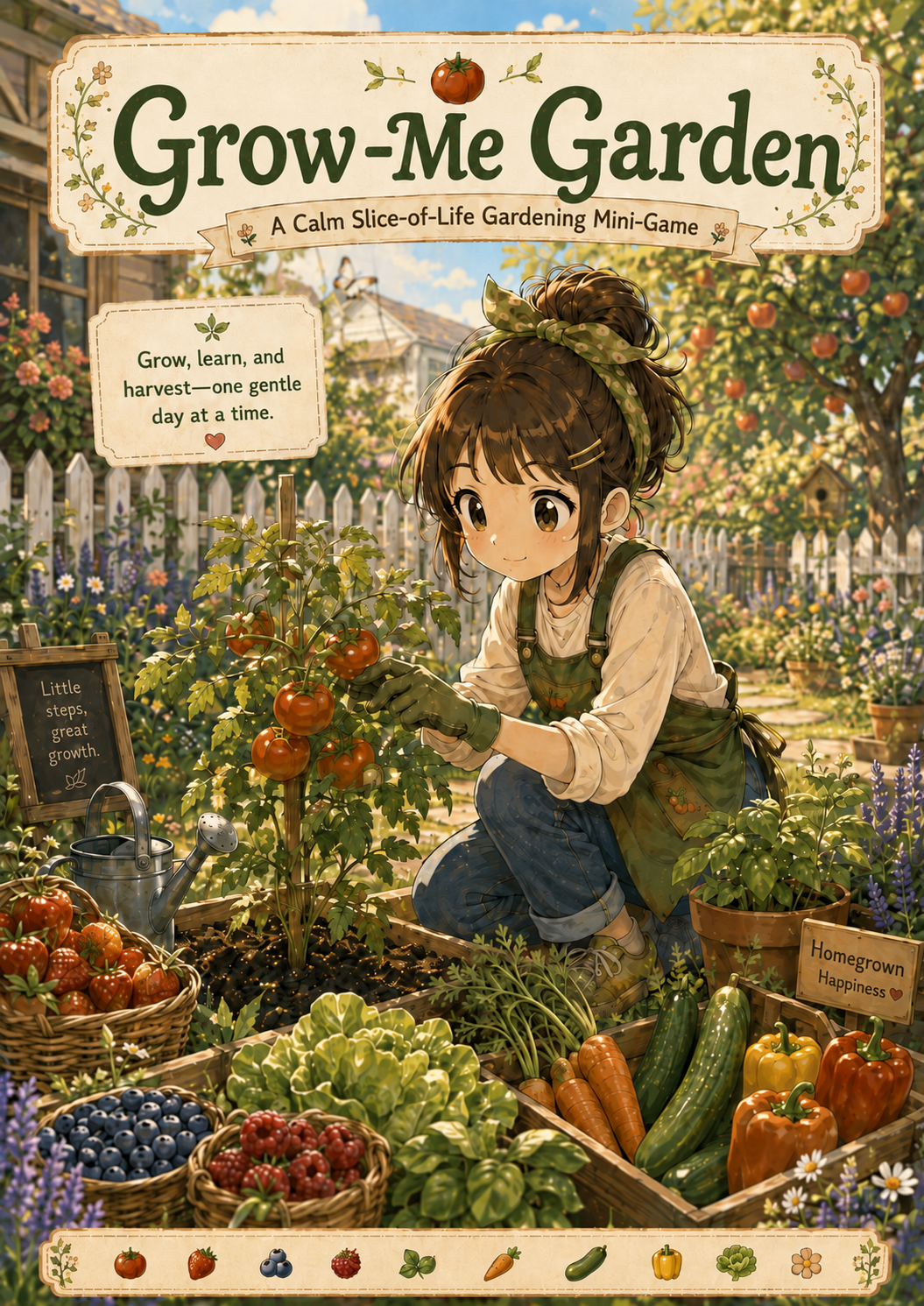
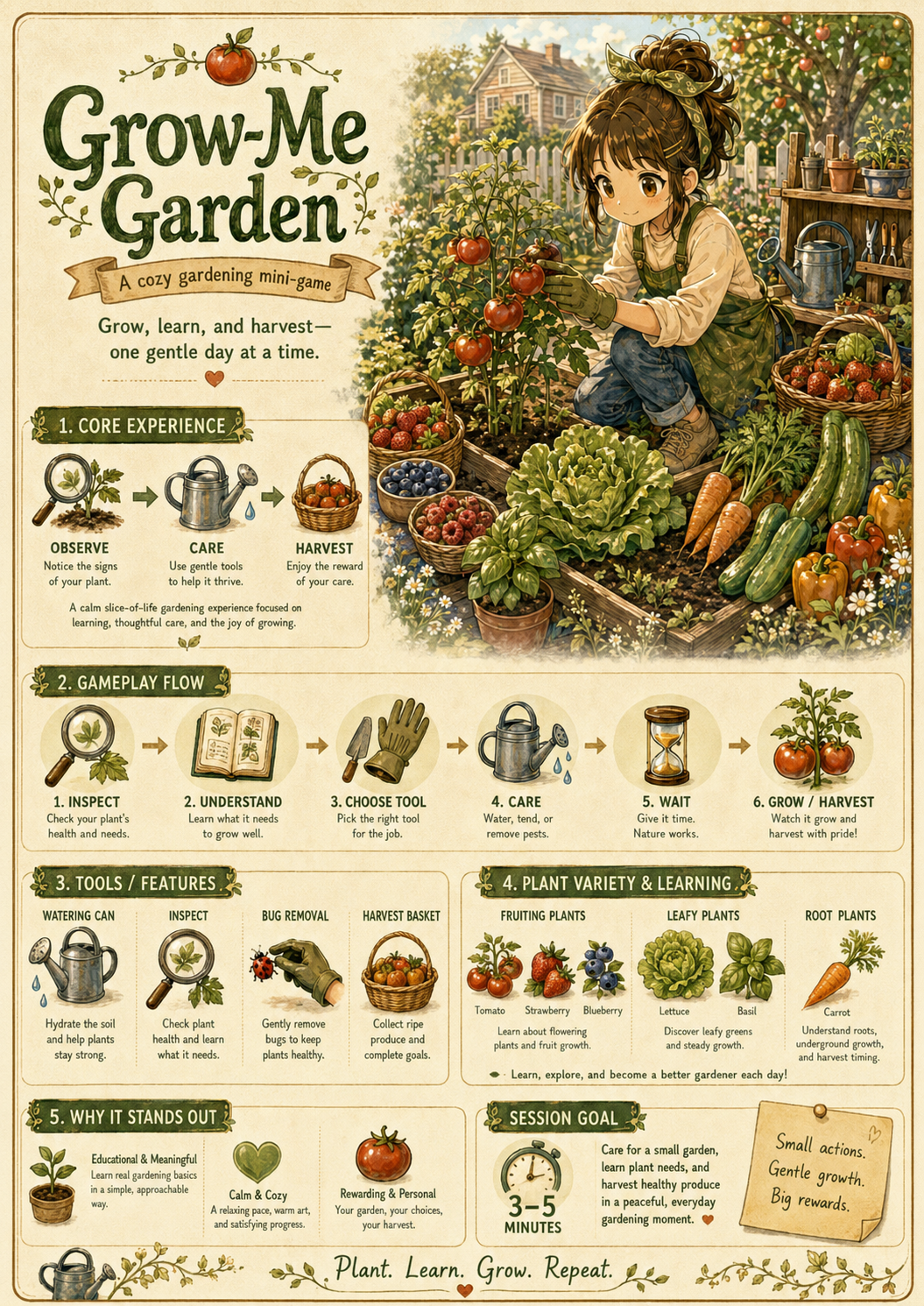
A calm garden-care game about learning to observe, understand, and respond before acting.
APPROVED ENGLISH FRONT SHEET // OPEN FULL SIZE
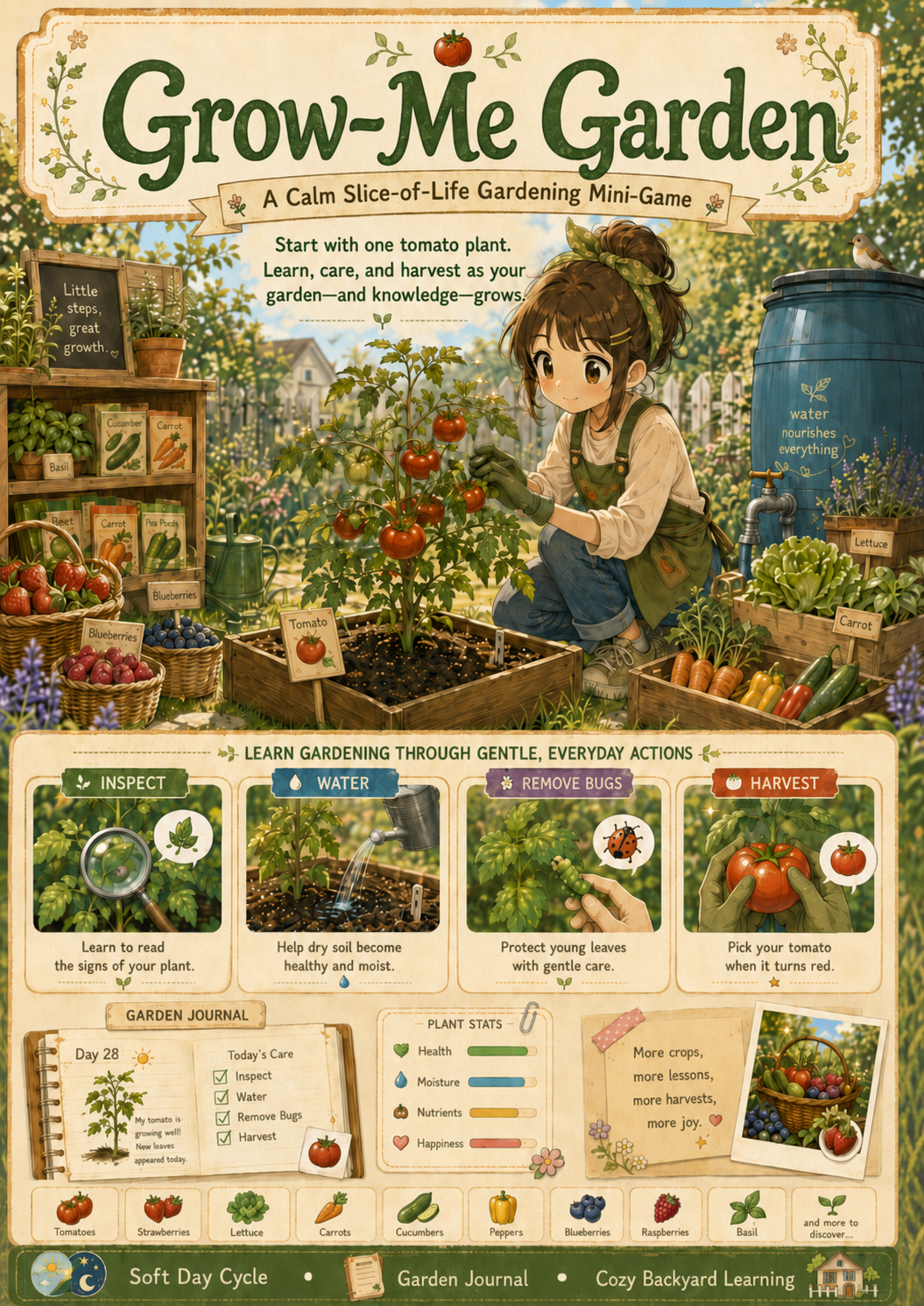
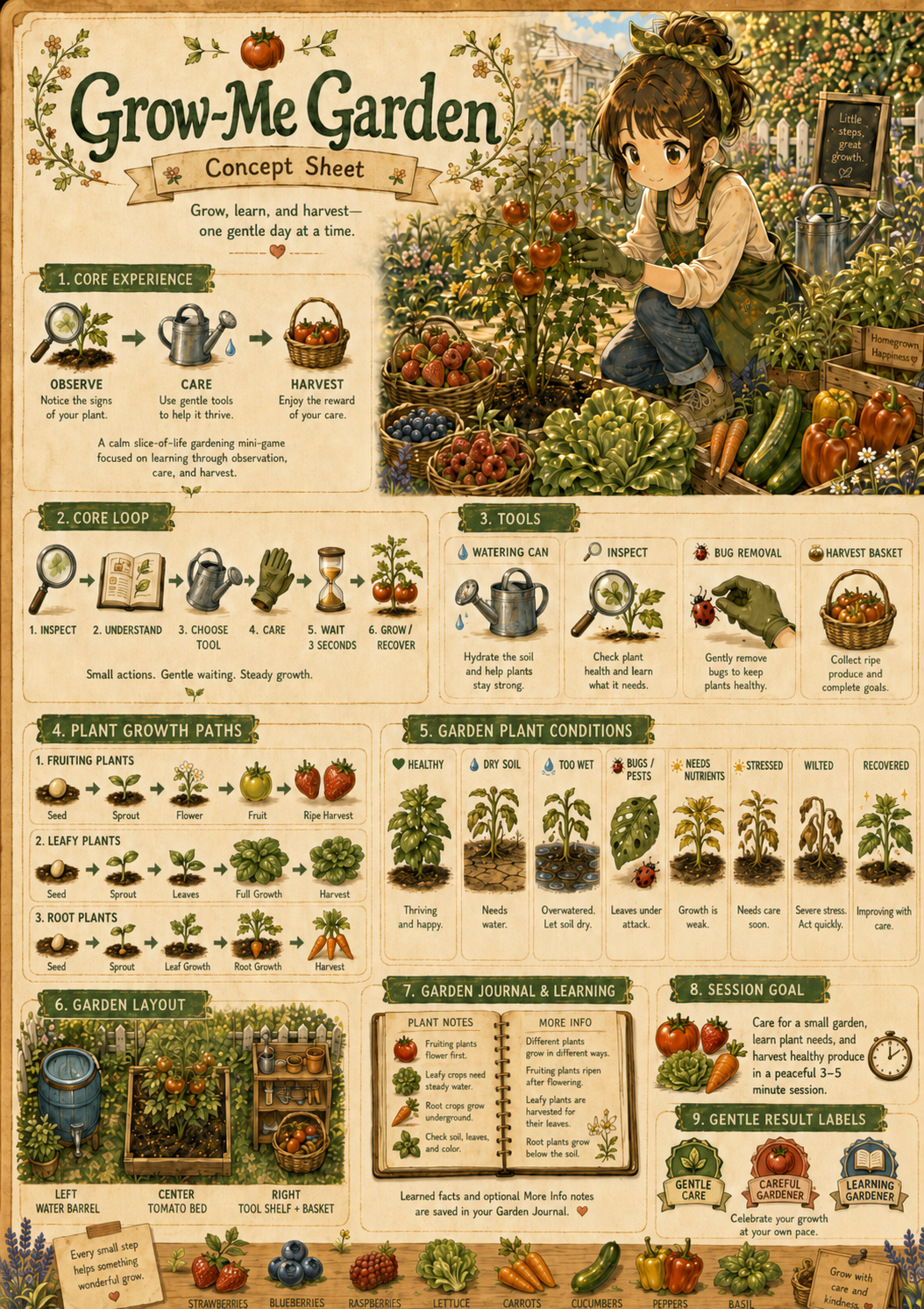
The first plan centered on a single backyard screen, one tomato plant, four tools, four growth stages, and a three-to-five-minute care cycle.
The local build expands that foundation into a selectable or randomized crop cycle with more plants, conditions, tools, and player identity choices.
The game rewards reading the garden, choosing the right response, and learning from recovery. Mistakes create stress without turning the experience into punishment.
The original tomato lesson grew into fruiting, leafy, and root crops with different tolerances, needs, traits, tips, and visual identities.
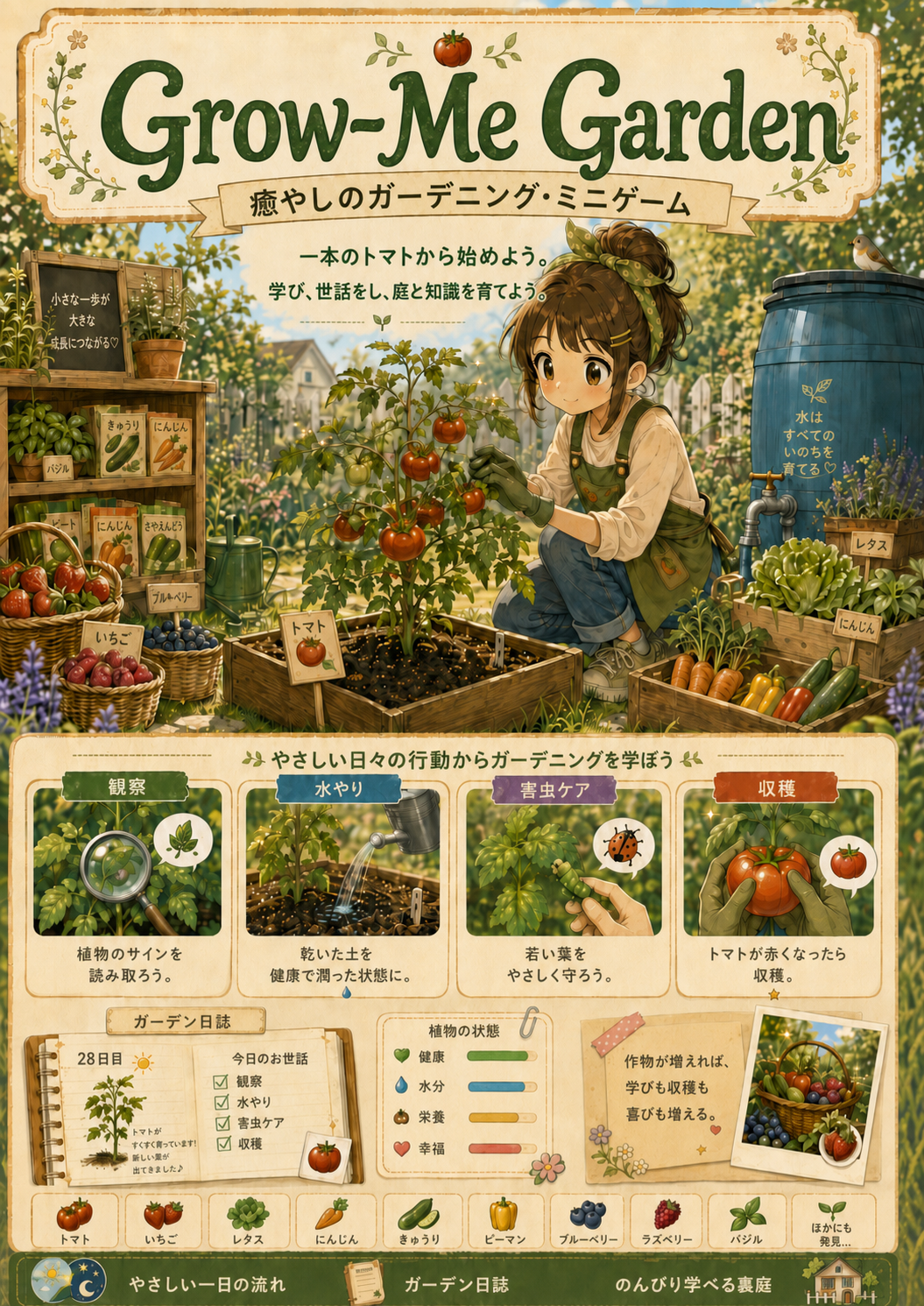
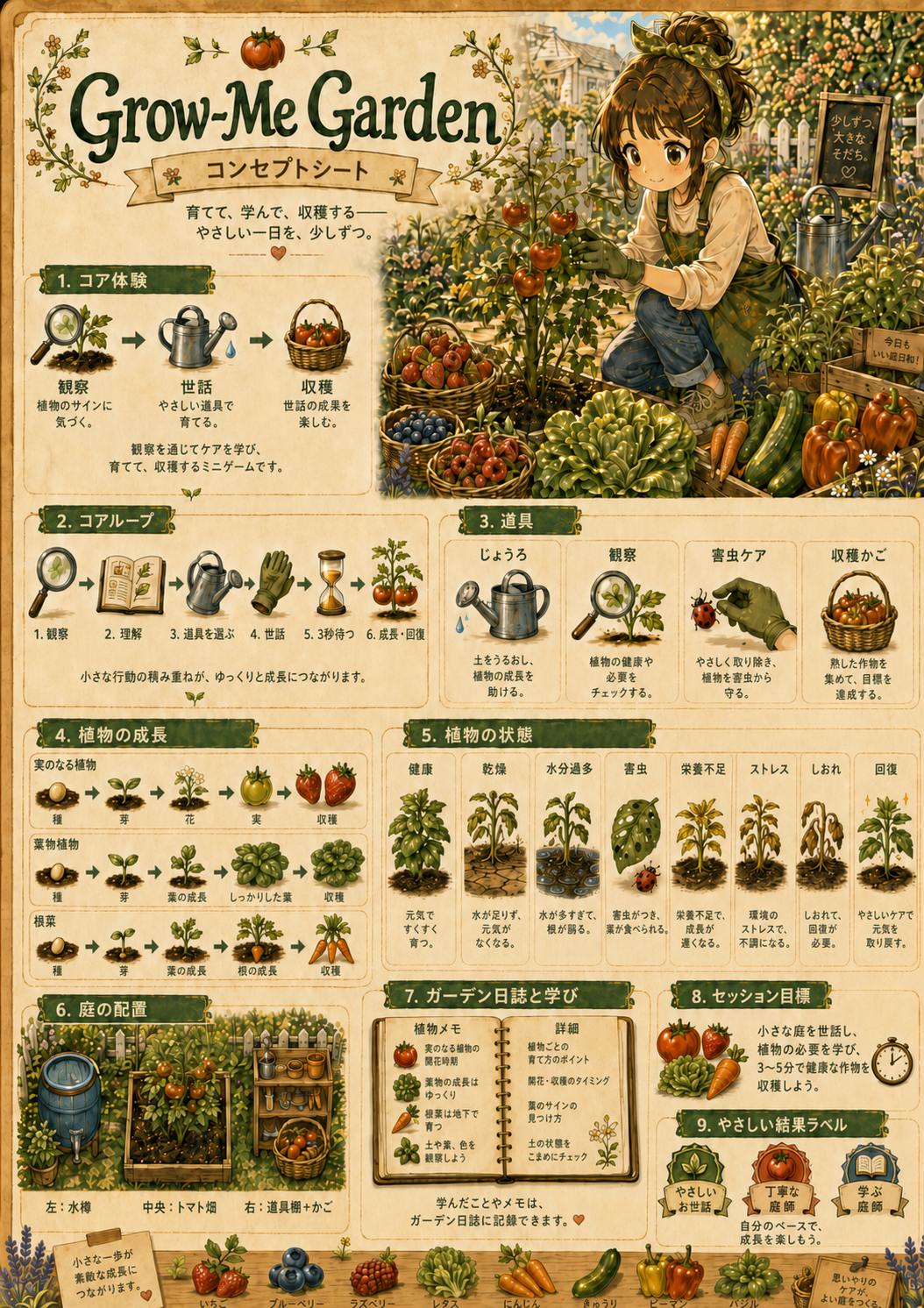
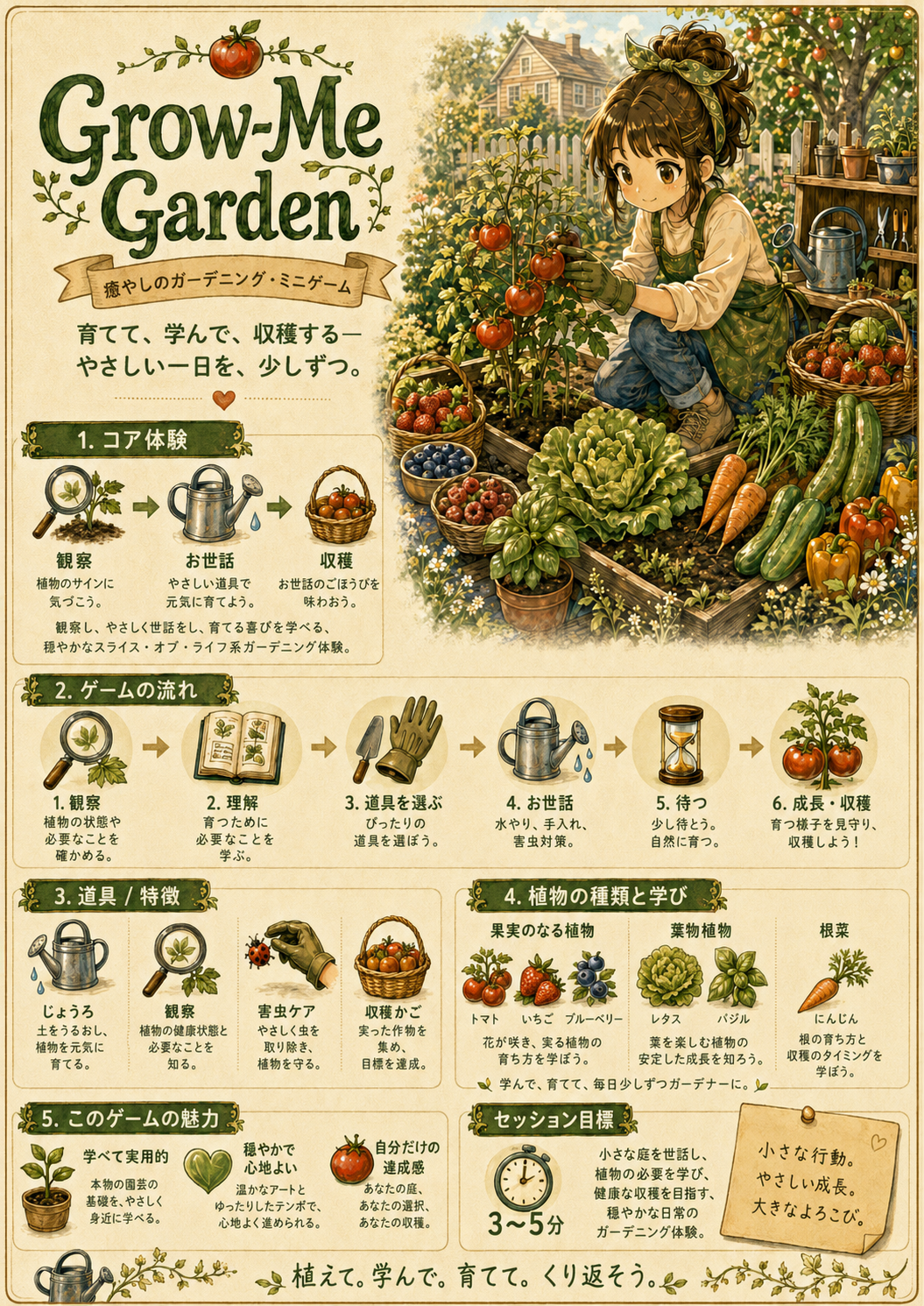
The recovered Japanese pitch sheet and three new localized counterparts are review candidates. The four locked English originals remain unchanged.
Select any sheet to inspect the original-resolution file.
English Front SheetApproved // Locked
English Back PackageApproved // Locked
English Concept SheetApproved // Locked
English Pitch SheetApproved // Locked
Japanese Front SheetLocal Review Candidate
Japanese Back PackageLocal Review Candidate
Japanese Concept SheetLocal Review Candidate
Japanese Pitch SheetRecovered Review Candidate
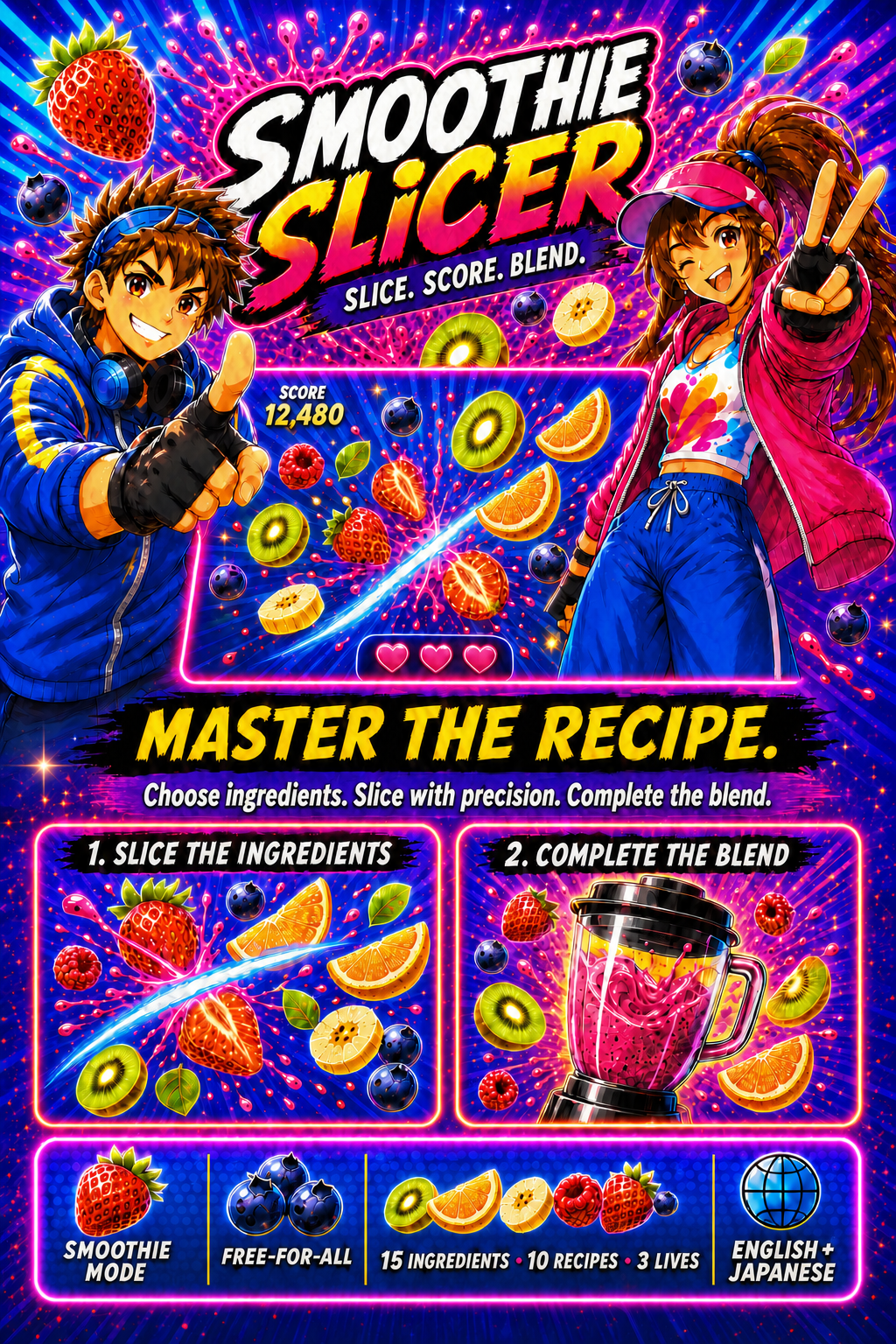
PROJECT RECORD // GG-SS-01
A fast, single-screen arcade game that turns smoothie recipes into a playful ingredient challenge.
SLICE · SCORE · BLEND
The design began as a short Fruit Ninja-style learning game: slice the right ingredients, avoid the wrong ones, then watch the completed smoothie blend.
The local build now offers recipe play and Free-for-All with fifteen ingredients, ten recipes, scoring, effects, lives, and a finished-drink showcase.
The blender sequence is more than a score screen. It gives the player a visible reward for learning a recipe and finishing the run.
The concept defines linear, arcing, and speed-pulse movement ratios that can support easy, normal, and hard pacing without losing ingredient clarity.
A true countdown, combo multiplier, letter grades, difficulty selection, phased pacing, structured waves, and strict challenge mode remain future work.
Select any sheet to inspect the full-resolution artwork.
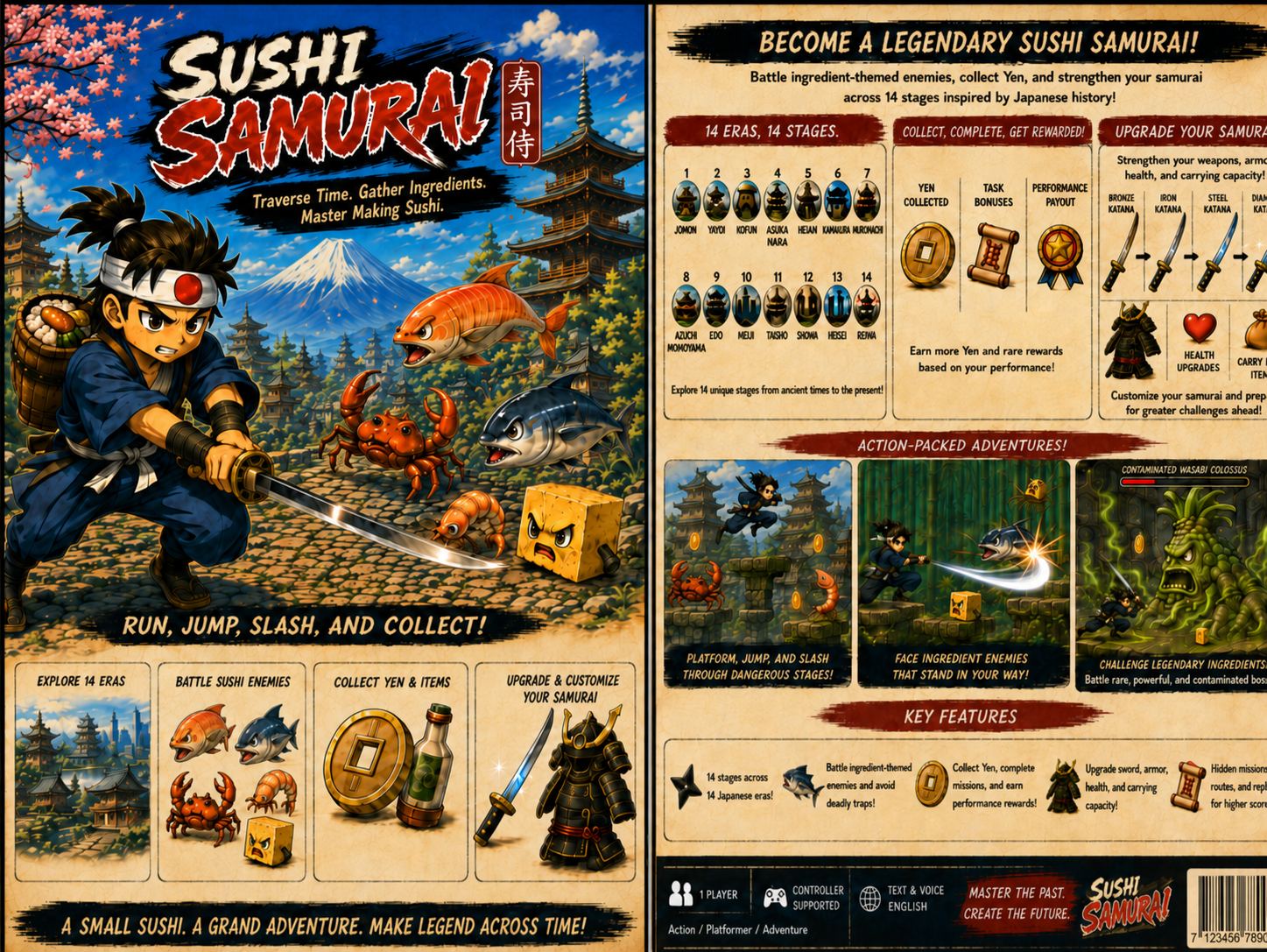
PROJECT RECORD // GG-SUS-01
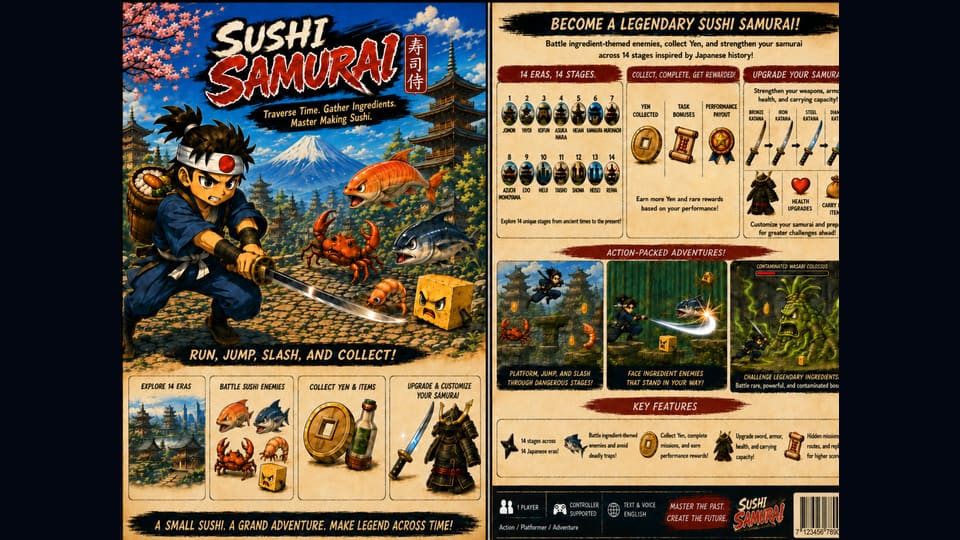
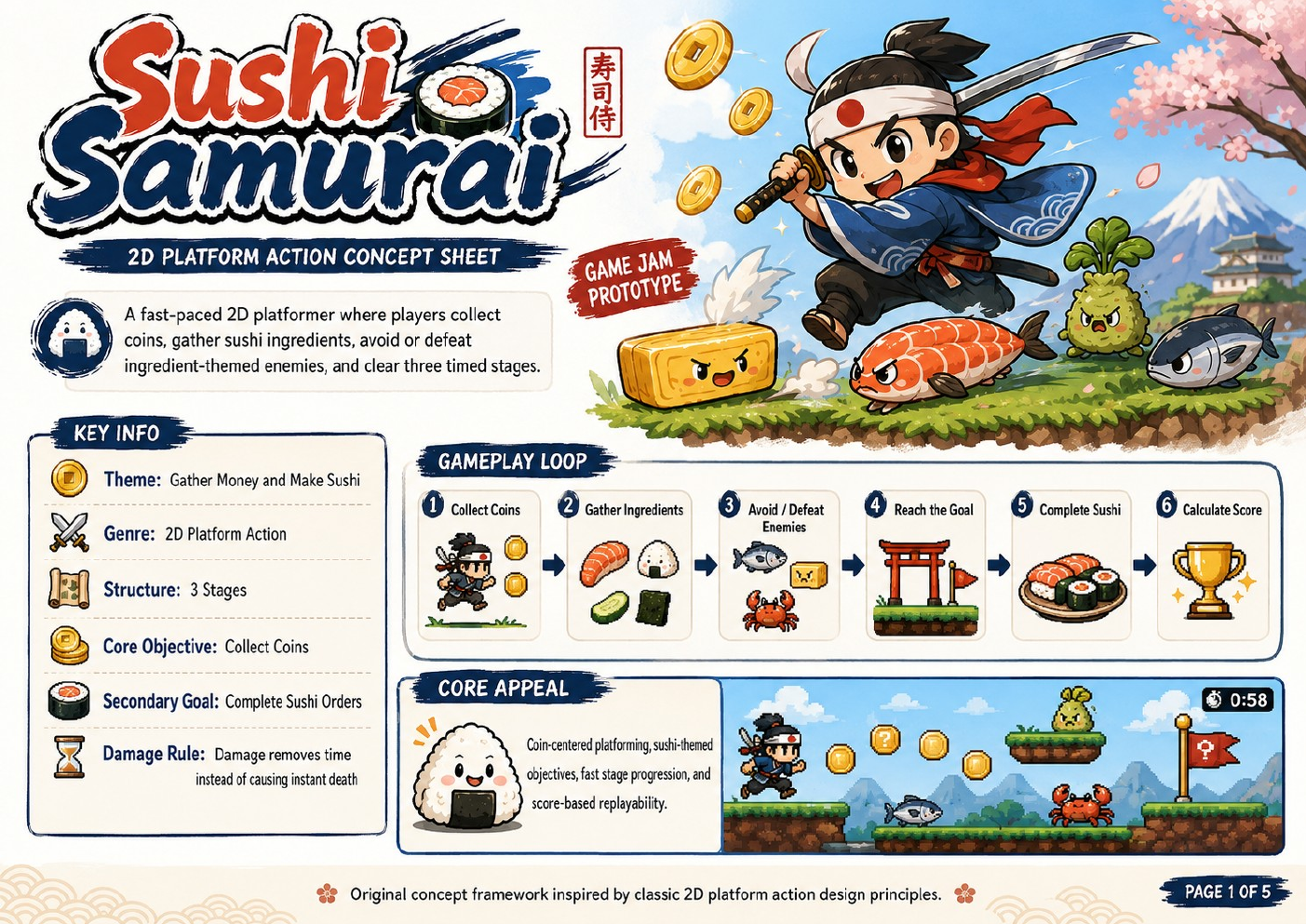
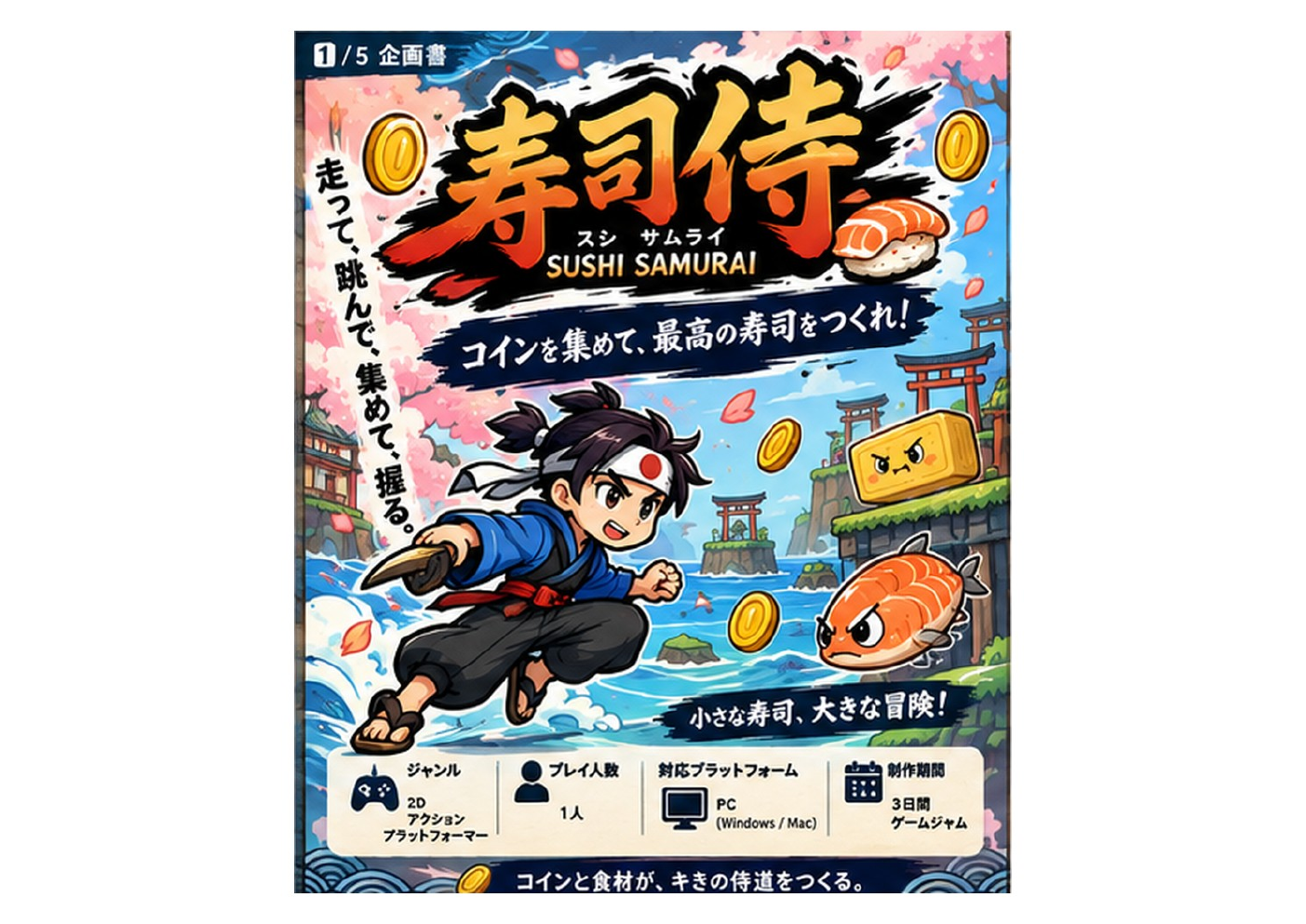
A fast 2D platform-action concept where coins, sushi ingredients, enemies, and a shrinking timer shape each run.
OFFICIAL ENGLISH FRONT + BACK // OPEN FULL SIZE
The player clears timed platforming stages by collecting the required coins and ingredients, handling themed hazards, reaching the goal, and completing the target sushi.
The current documentation defines a tight three-day prototype target rather than presenting Sushi Samurai as a completed release.
The plan moves from basic movement and coin paths to vertical routes, guarded areas, combined hazards, and high-risk coin lines.
Coins, required ingredients, items, defeated enemies, remaining time, and completed sushi all contribute to the stage score.
A Windows Unity prototype is preserved in the project archive. It is not browser-hosted, release-ready, or offered here as a public download.
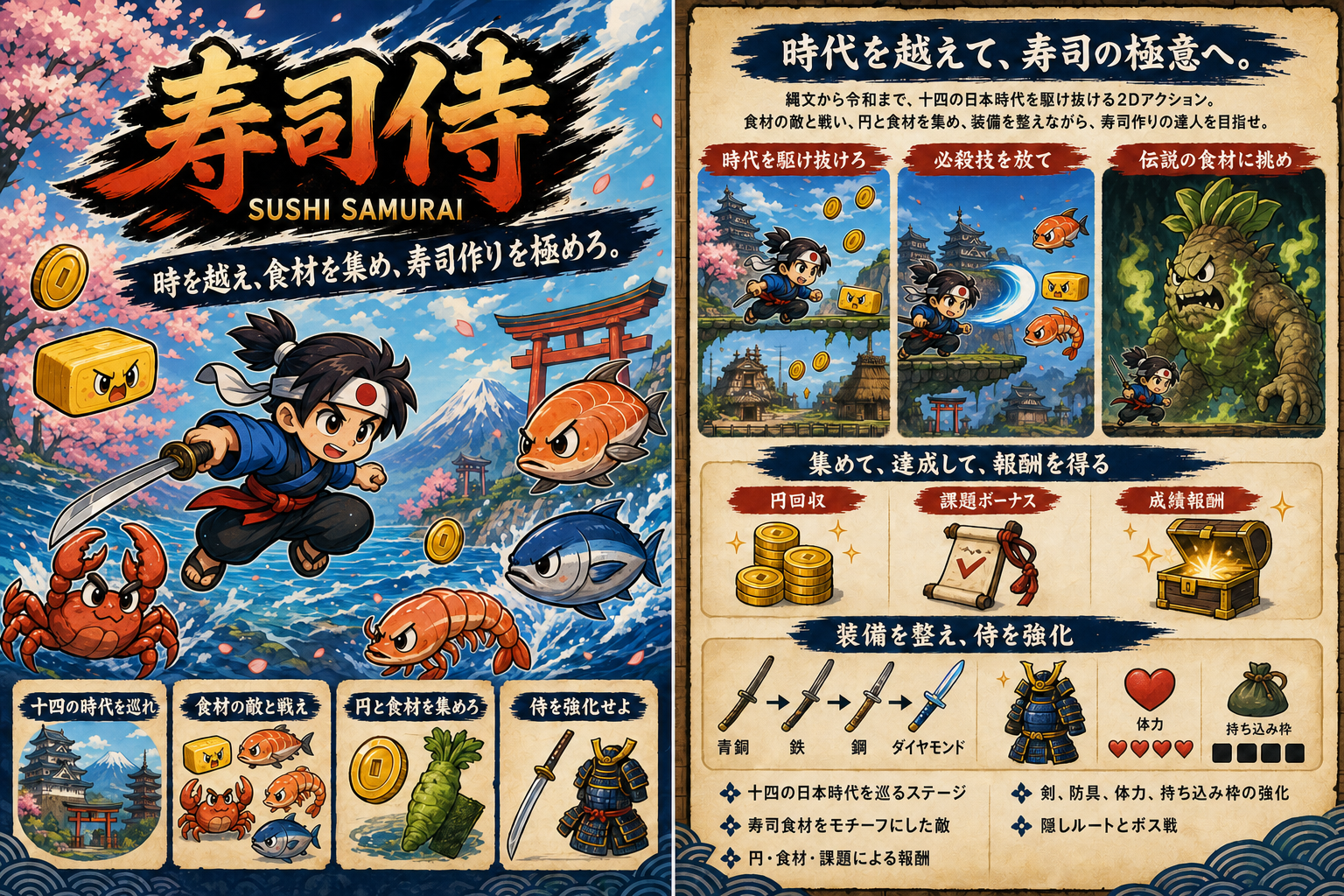
The English sheet is the locked package master. The Japanese sheet remains a draft because its protagonist still needs to match the English character's age and proportions.
Open the complete English/Japanese planning sets and the Japanese Unagi enemy specification.
PROJECT RECORD // GG-ROR-01
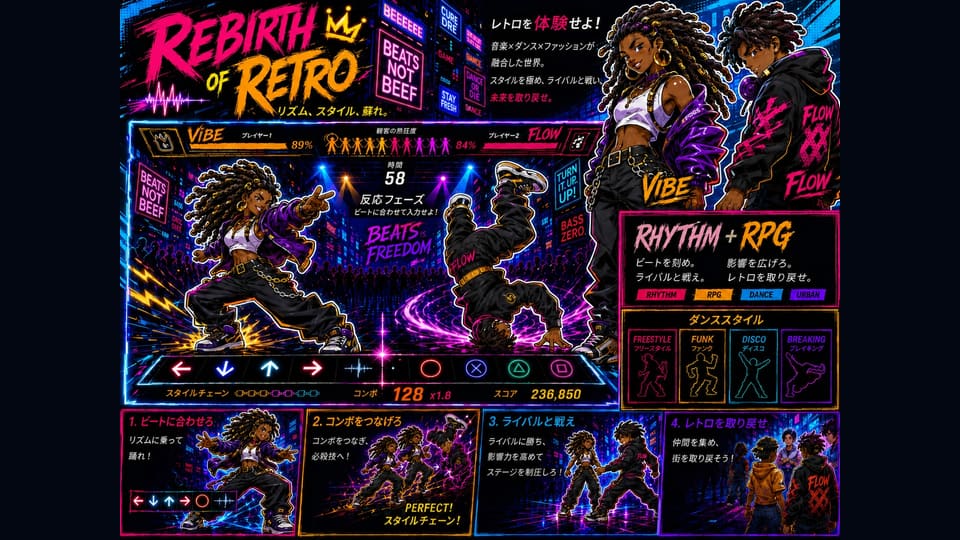
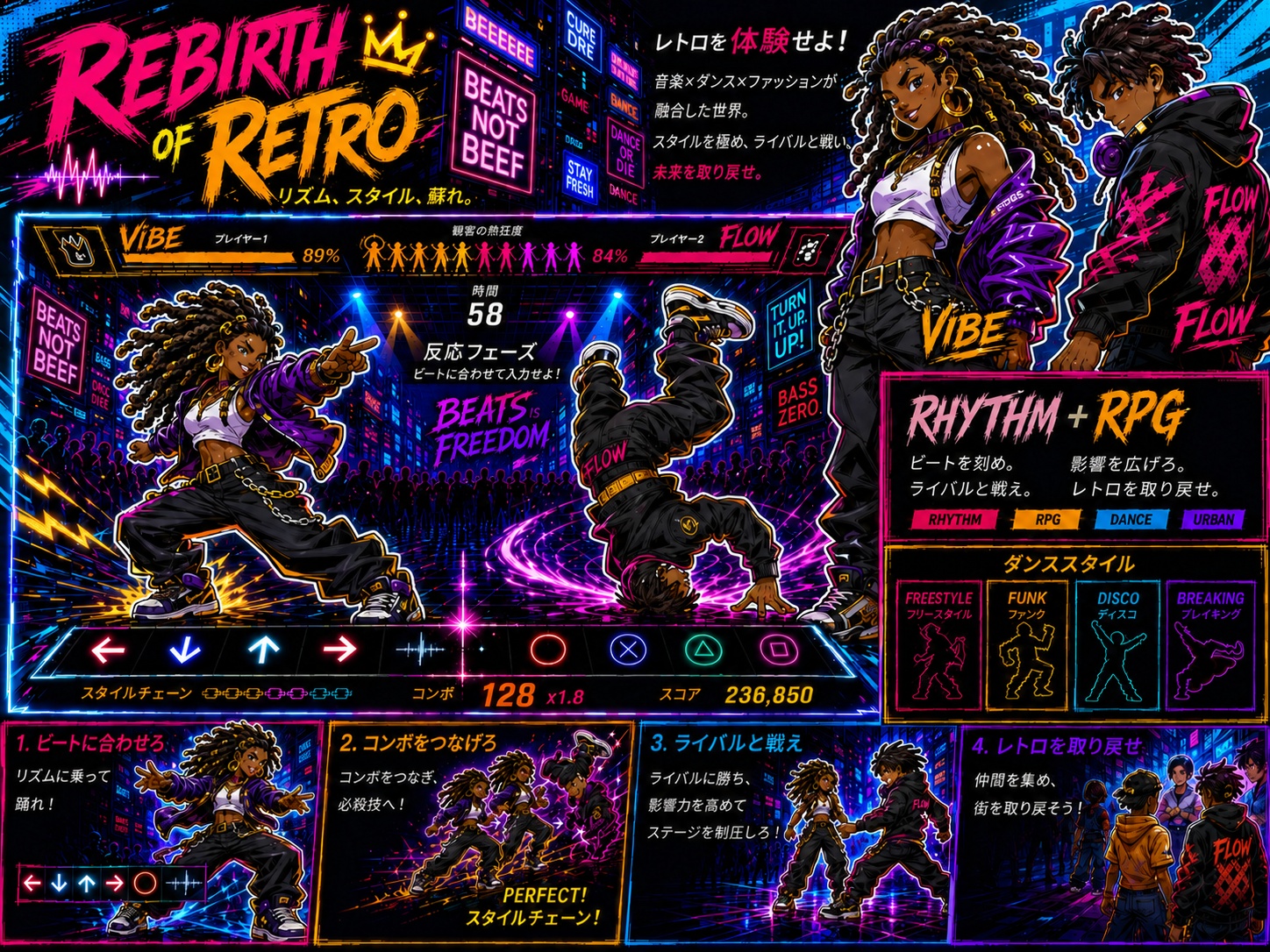
A performance-action RPG concept where Flow and Vibe use dance battles to reclaim a living world of music, style, memory, and culture.
CURRENT MASTER SELL SHEET // OPEN FULL SIZE
Retro is a living world formed from nostalgic music, dance, fashion, art, memories, and human connection. As that connection fades, hostile forces consume and control it.
The concept combines beat-matching, linked inputs, style chains, rival battles, and audience response in a hybrid rhythm-RPG framework.
The two protagonists anchor the game's urban dance identity and embody the player-facing relationship between rhythm, style, and cultural memory.
The current master uses high-contrast neon, graffiti-like typography, arcade interface panels, and distinct style colors to sell the battle fantasy immediately.
The world, protagonists, core narrative hook, dance styles, battle direction, and current sell-sheet baseline are defined; this record does not present a finished playable release.
Select any sheet to inspect the original-resolution file.
PROJECT RECORD // GG-STB-01
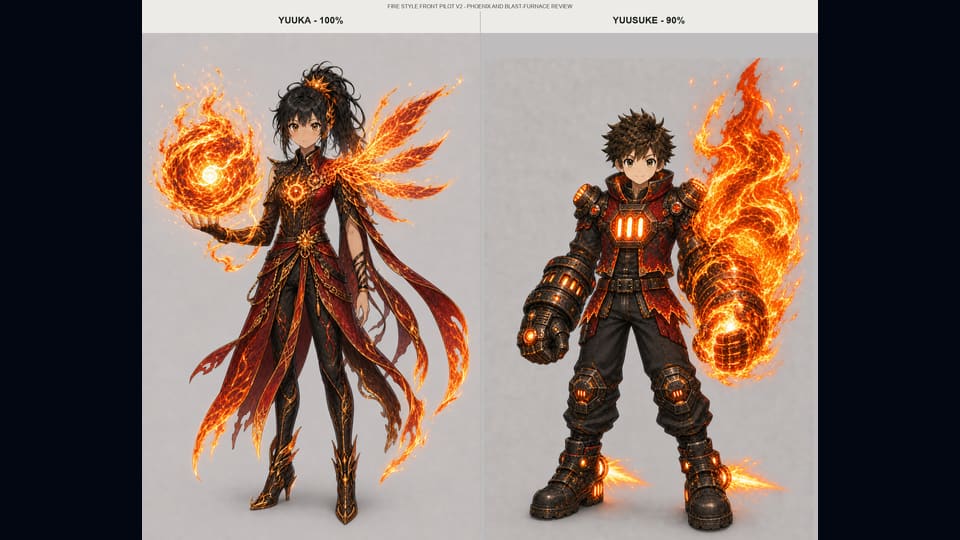
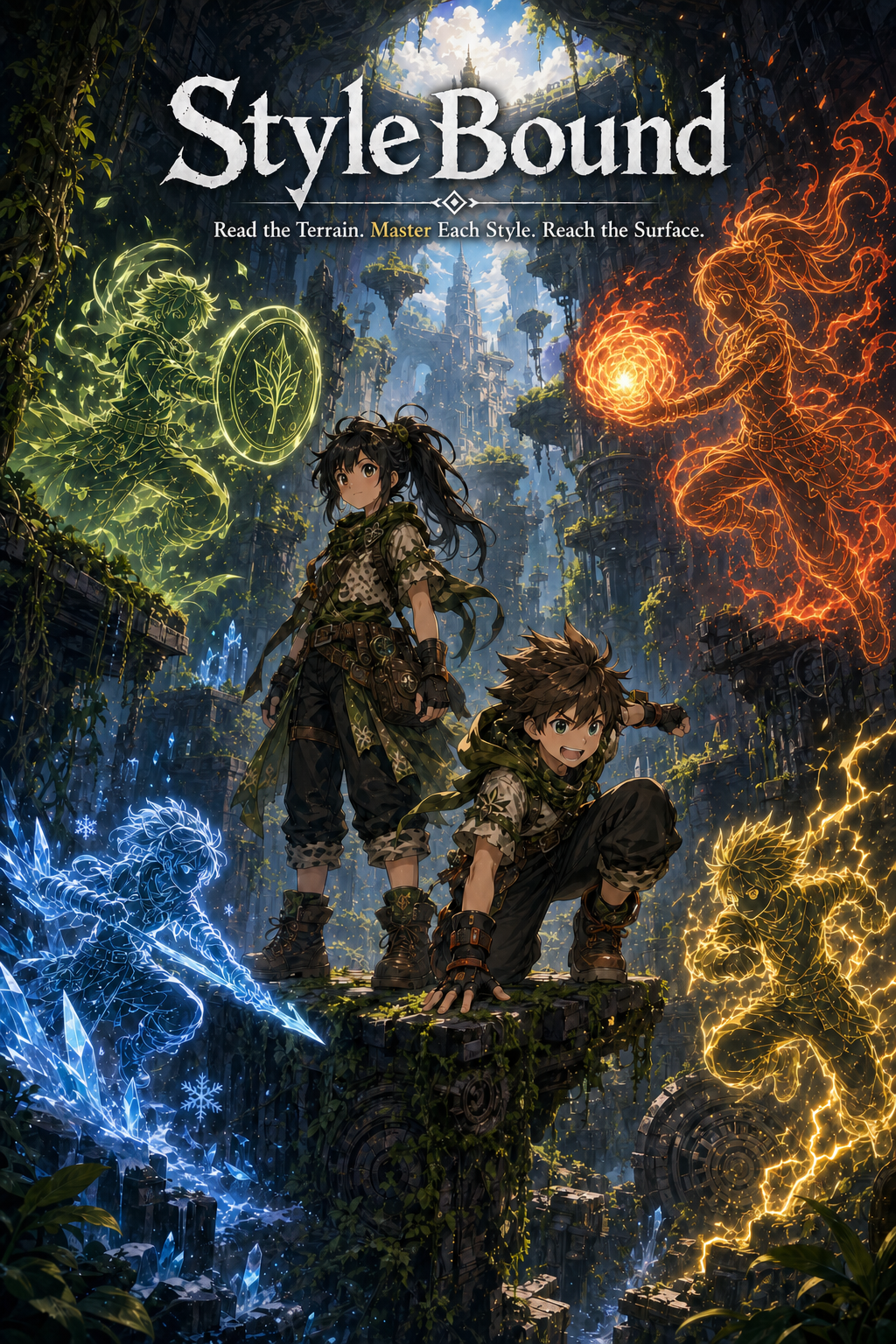
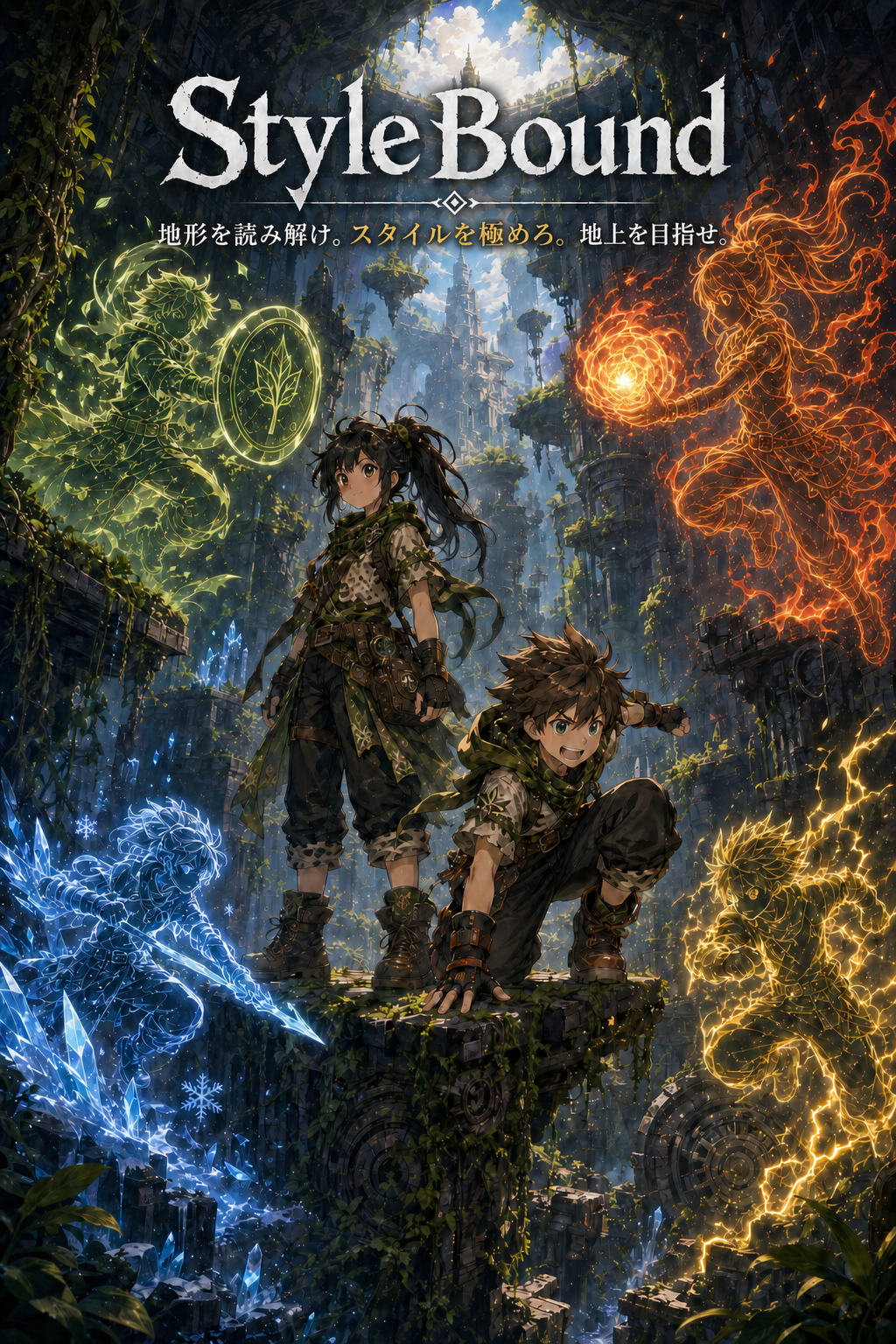
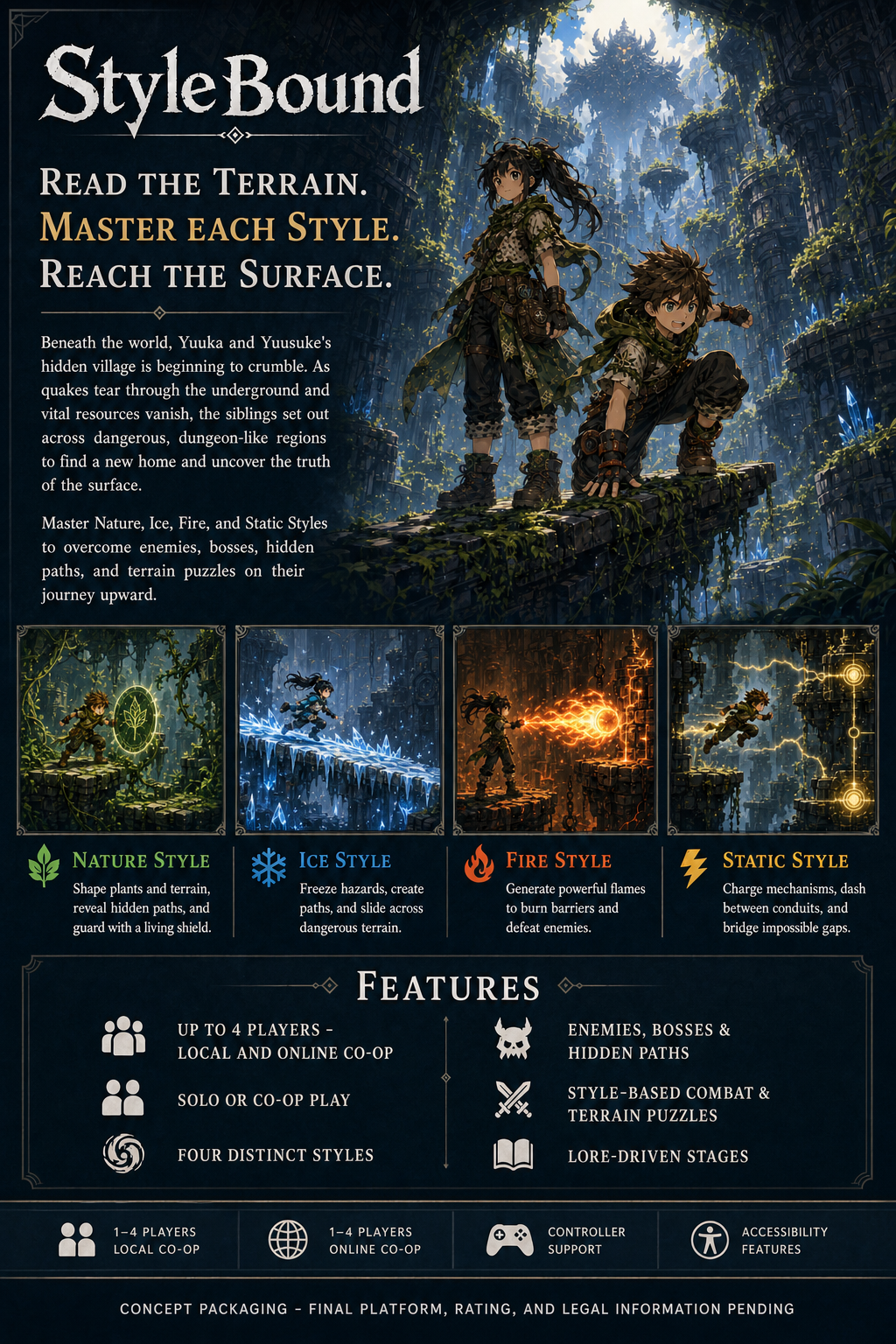
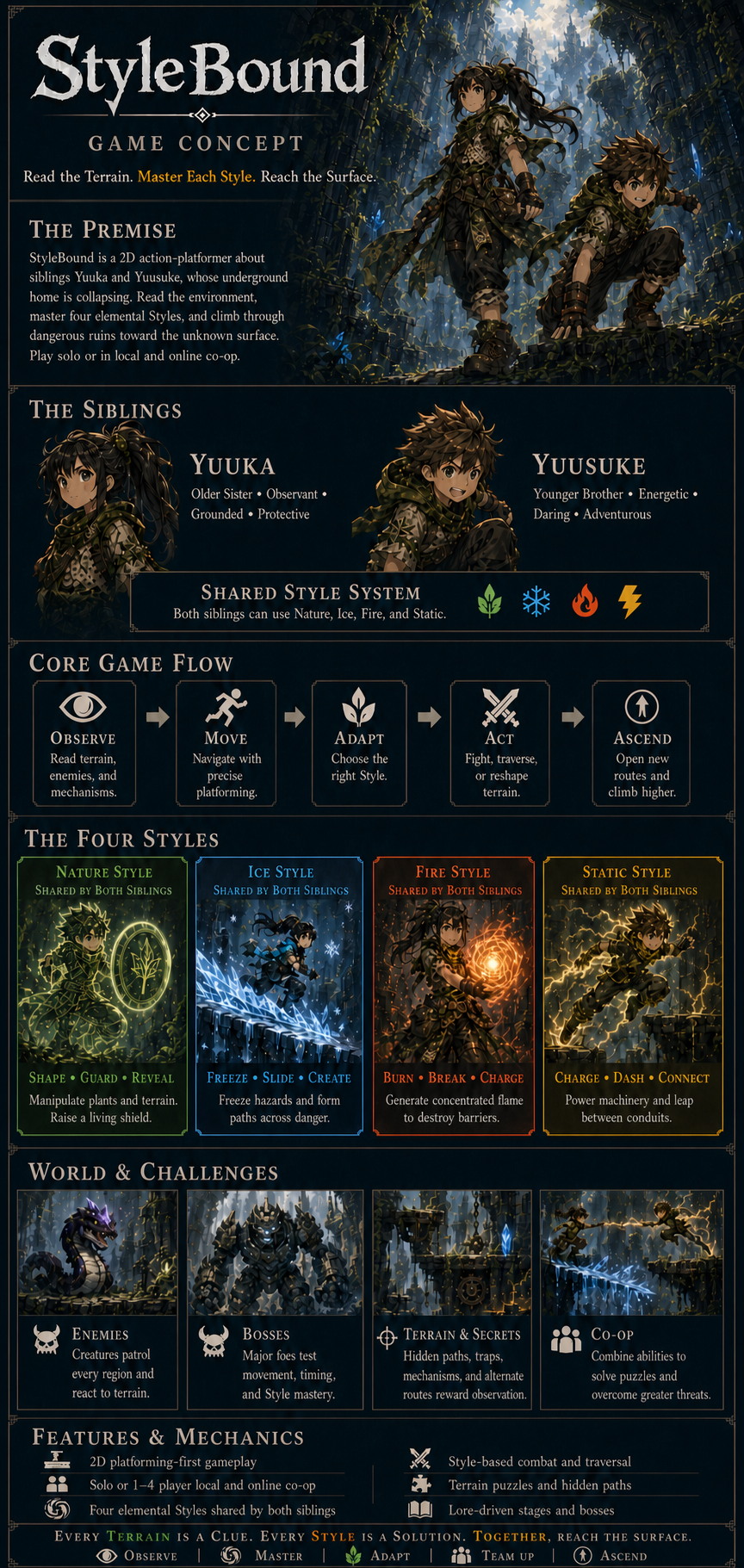
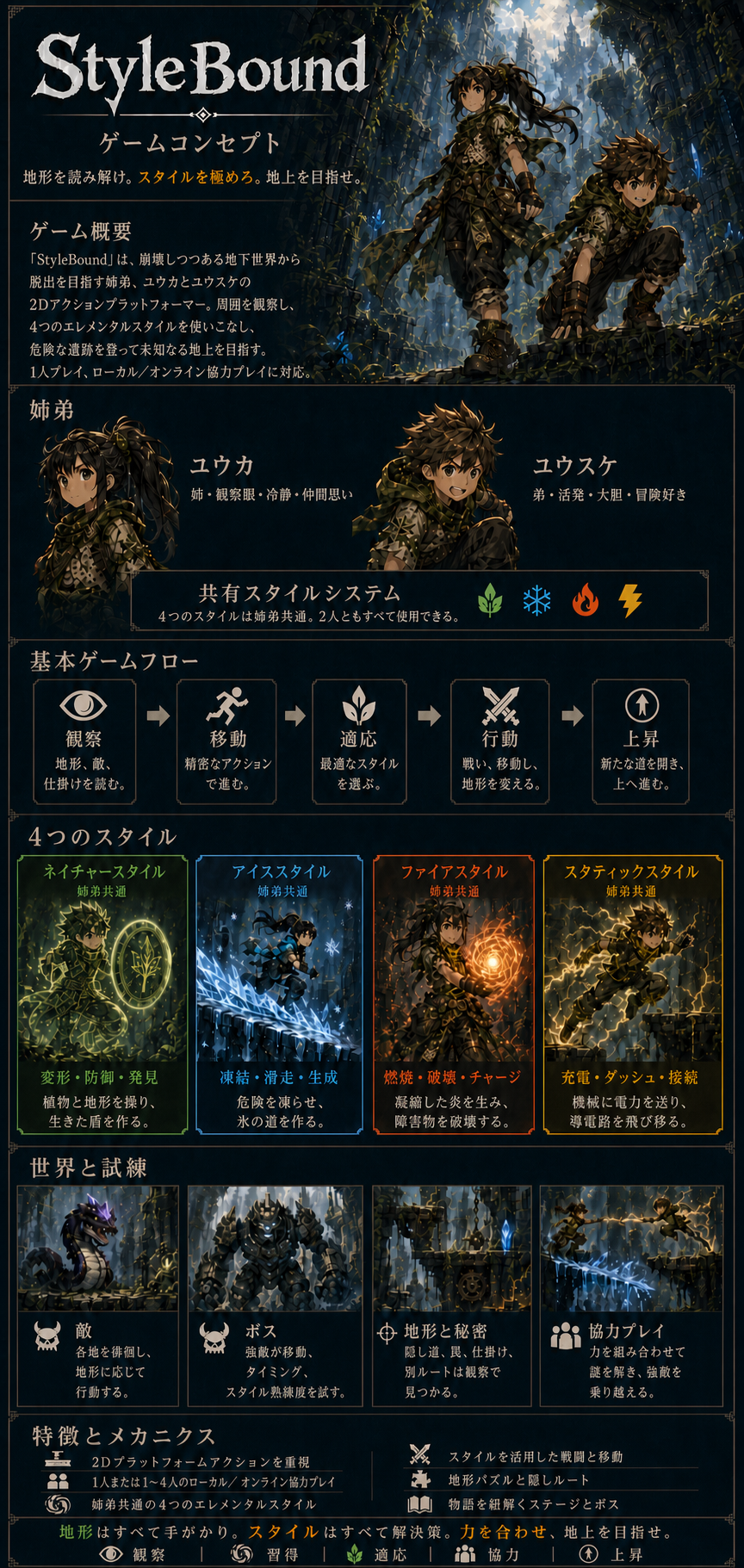
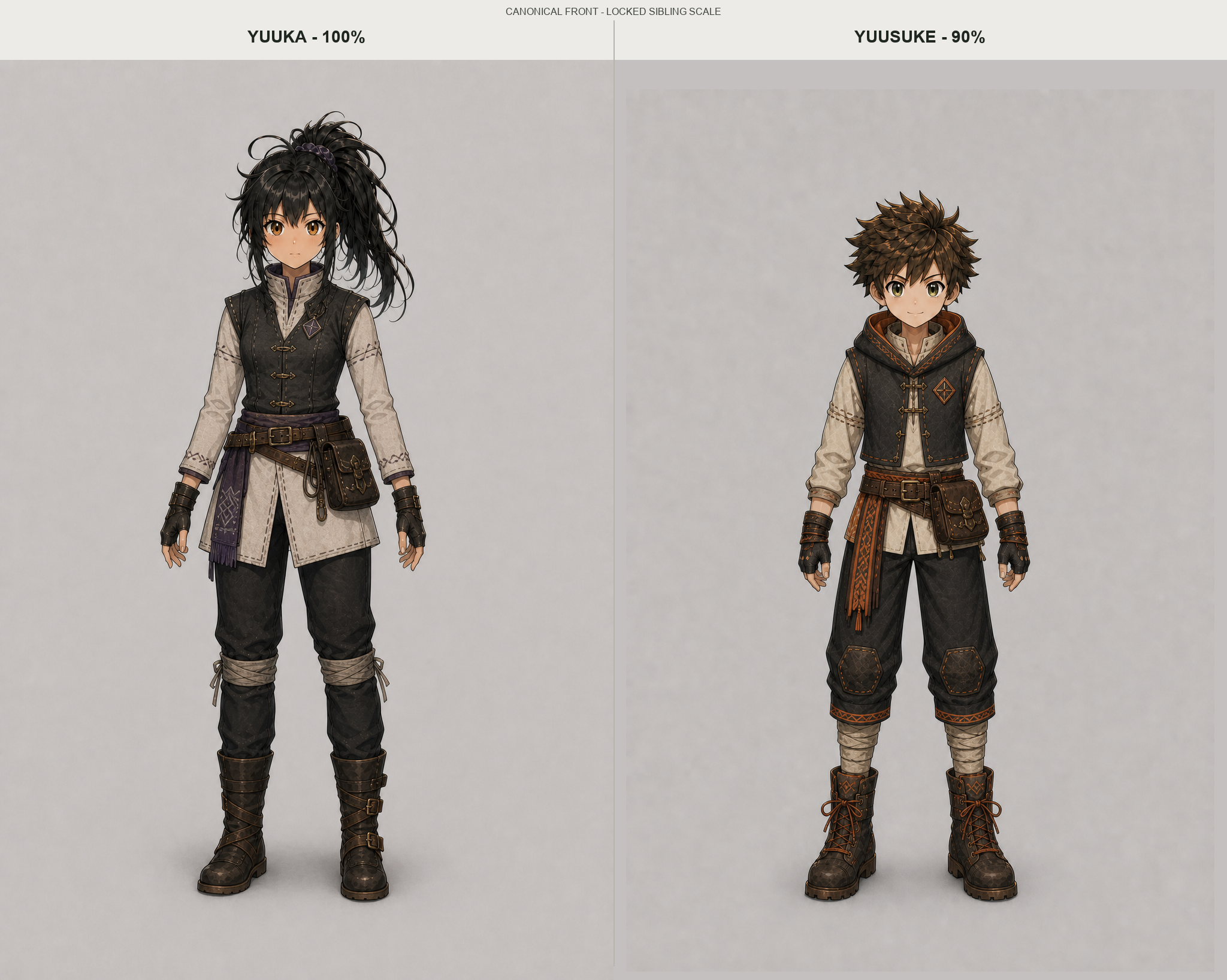
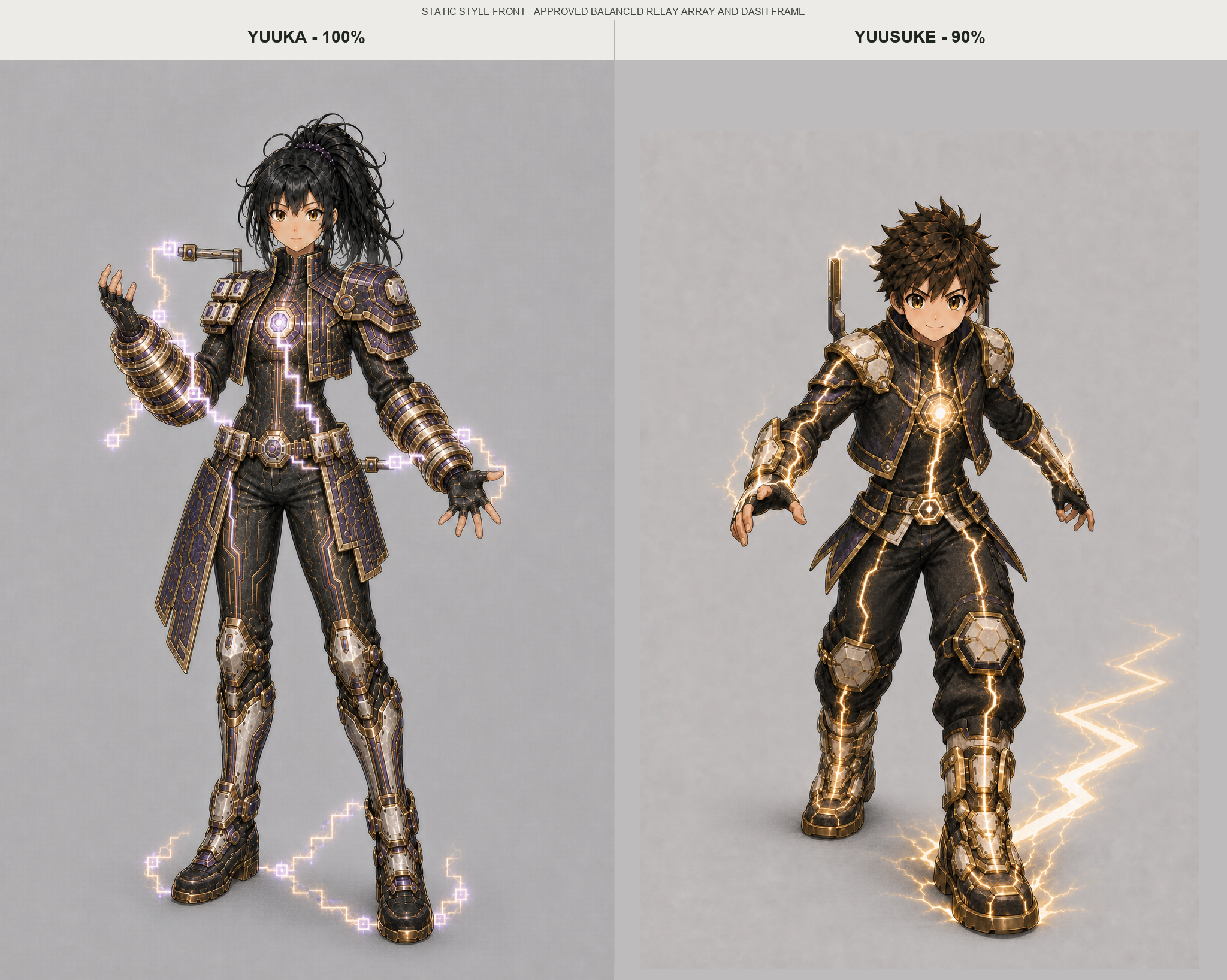
A 2D action-platformer about siblings Yuuka and Yuusuke reading dangerous terrain, mastering four shared Styles, and climbing from a collapsing underground world toward an unknown surface.
LOCKED ENGLISH FRONT // OPEN FULL SIZE
As their underground home begins to collapse, Yuuka and Yuusuke travel through dangerous dungeon-like regions, uncover hidden routes, and search for a new home without revealing what waits above.
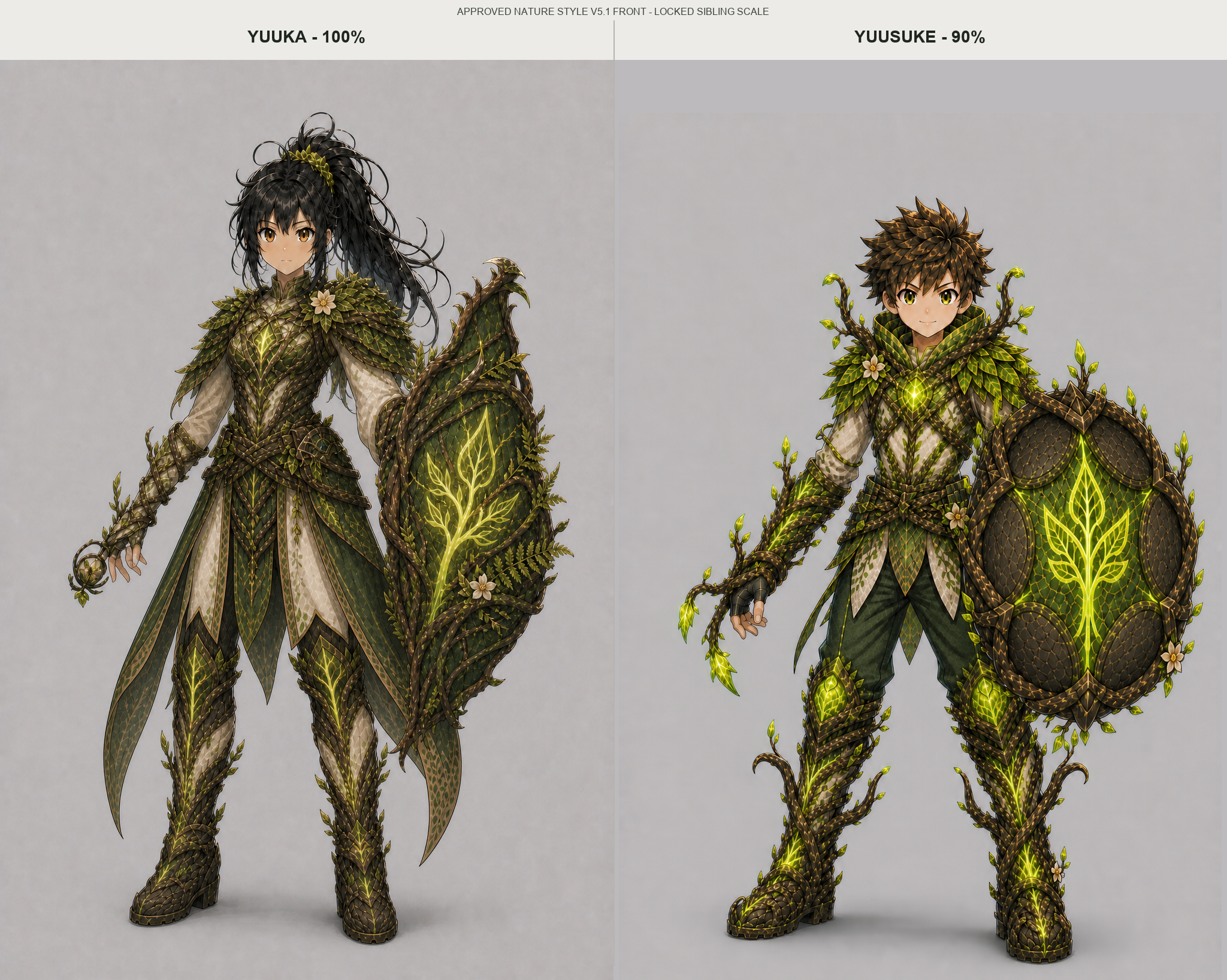
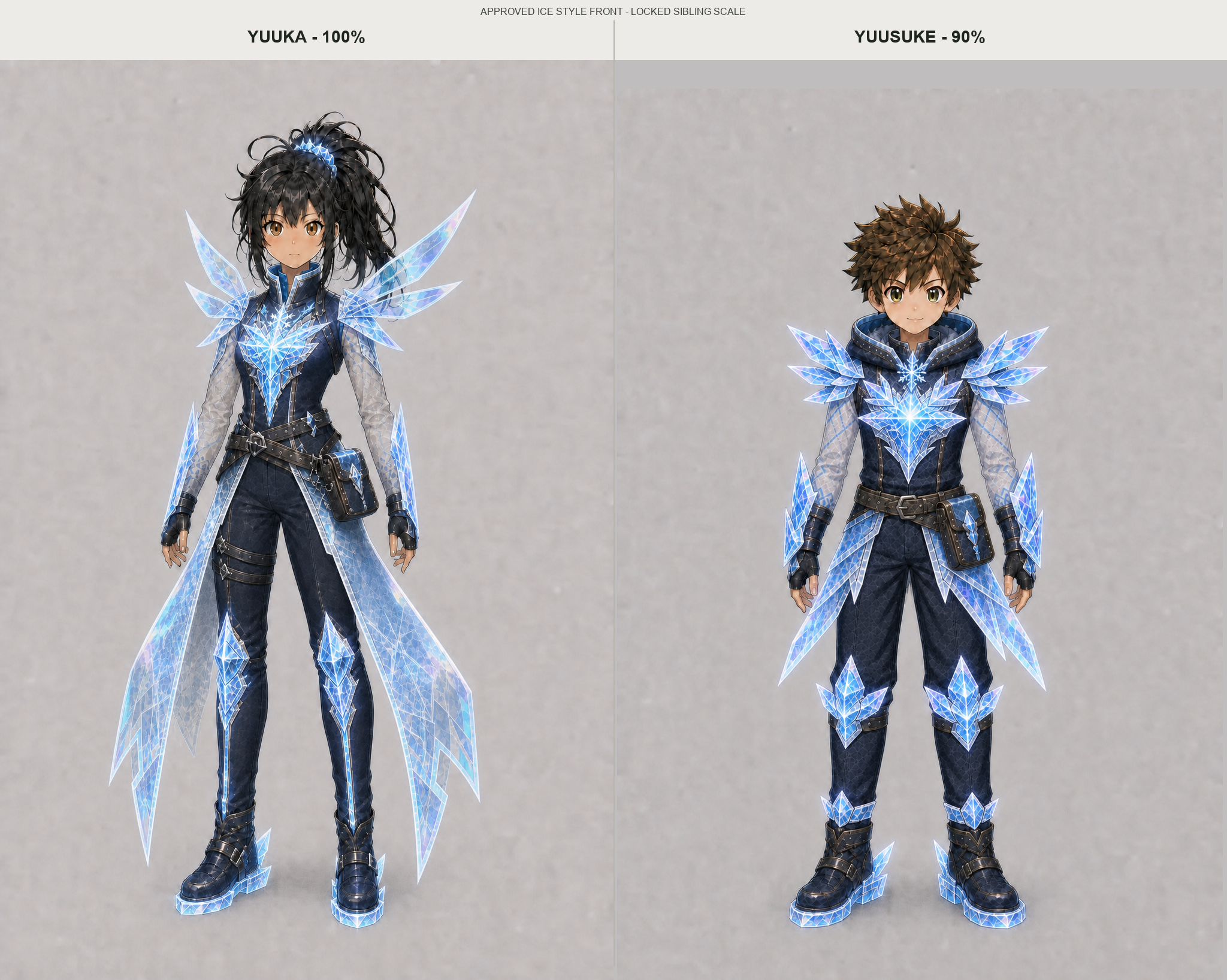
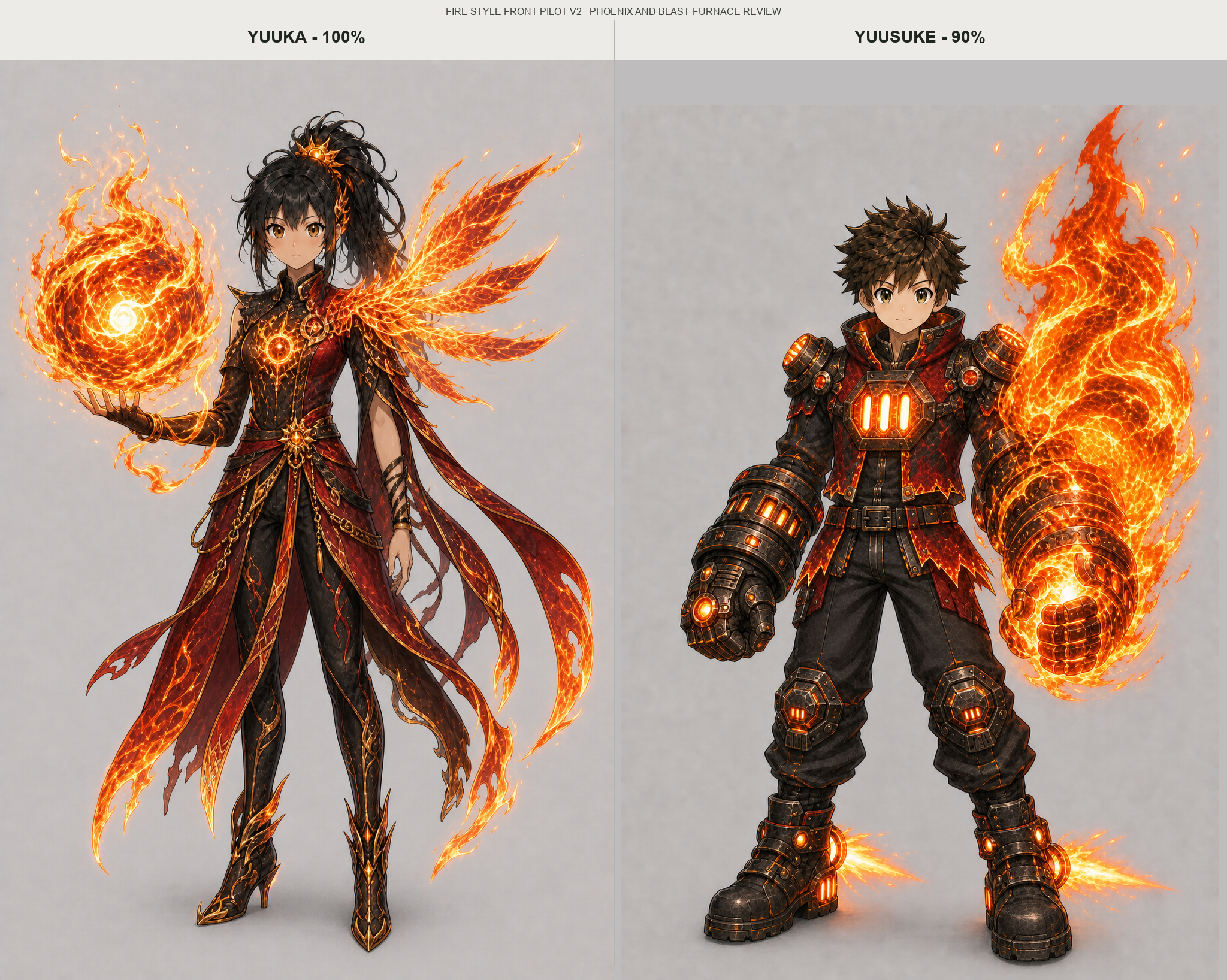
Nature, Ice, Fire, and Static are shared transformation systems. Each changes combat, traversal, terrain interaction, and the routes the player can read or create.
The older sister is grounded, observant, and protective; the younger brother is energetic, daring, and adventurous. Their exact-scale relationship and current Base designs are locked.
Progress comes from reading terrain and mechanisms, moving precisely, choosing the right Style, acting on the environment, and opening a route upward.
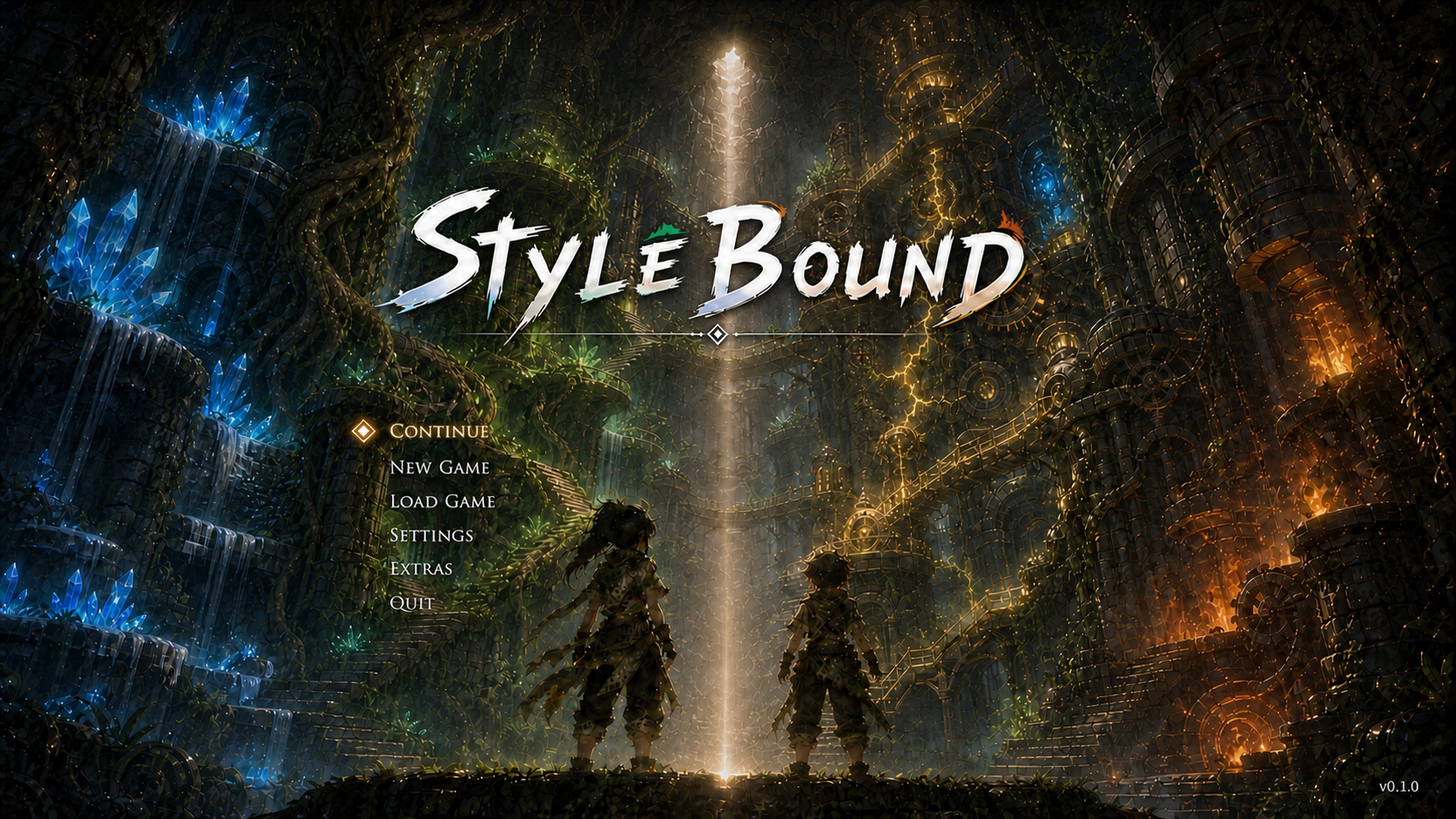
The premise, bilingual presentation set, current title screen, Base siblings, and all four shared Style directions are established. A completed public playable build is not represented here.
Select any sheet to inspect the original-resolution file.
These boards preserve Yuuka at 100%, Yuusuke at 90%, and the approved shared Nature, Ice, Fire, and Static directions.
PROJECT RECORD // GG-LXC-01
A competitive strategy card game about building evolving networks of people, connections, support, responses, history, and finite opportunities.
Players create value through Characters, Connections, Support, Responses, Developments, and recorded history before finite opportunities carry the match into its Final Chapter.
The turn player normally has priority to attempt a plan. Response windows create controlled tactical interaction, and resolved cards can remain meaningful as part of the network's history.
Build around people, relationships, preparation, risk, and adaptation—then find combinations that feel both deliberately prepared and cleverly improvised.
Character growth, Joint Developments, Connections, recorded history, finite opportunities, priority, and Response Windows create replayable networks without relying on a single correct strategy.
The core identity, goal, card families, classifications, turn structure, endgame direction, and English concept sheet are established. Detailed specifications, testing, a Japanese sheet, physical prototyping, balancing, packaging, and publication remain future work.
Select any sheet to inspect the original-resolution file.
PROJECT RECORD // GG-CC-01
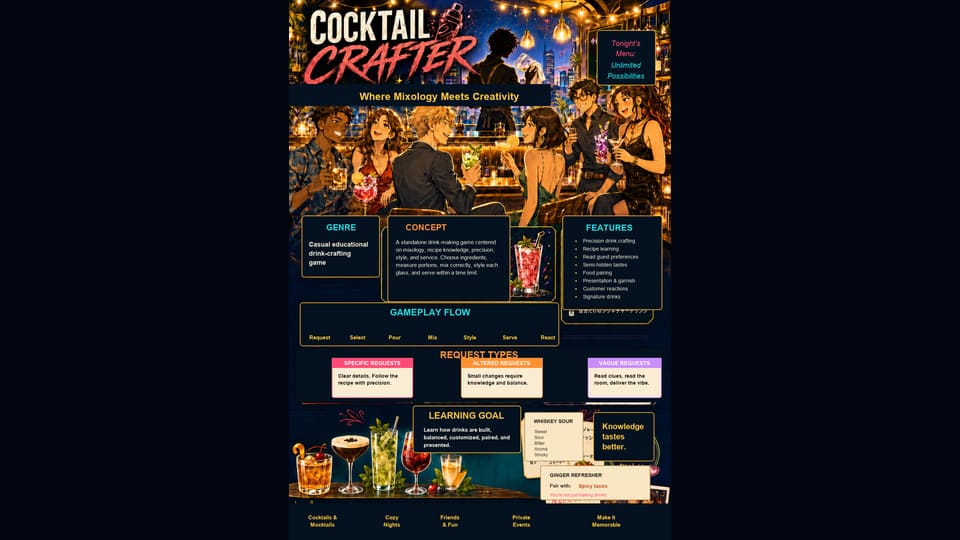
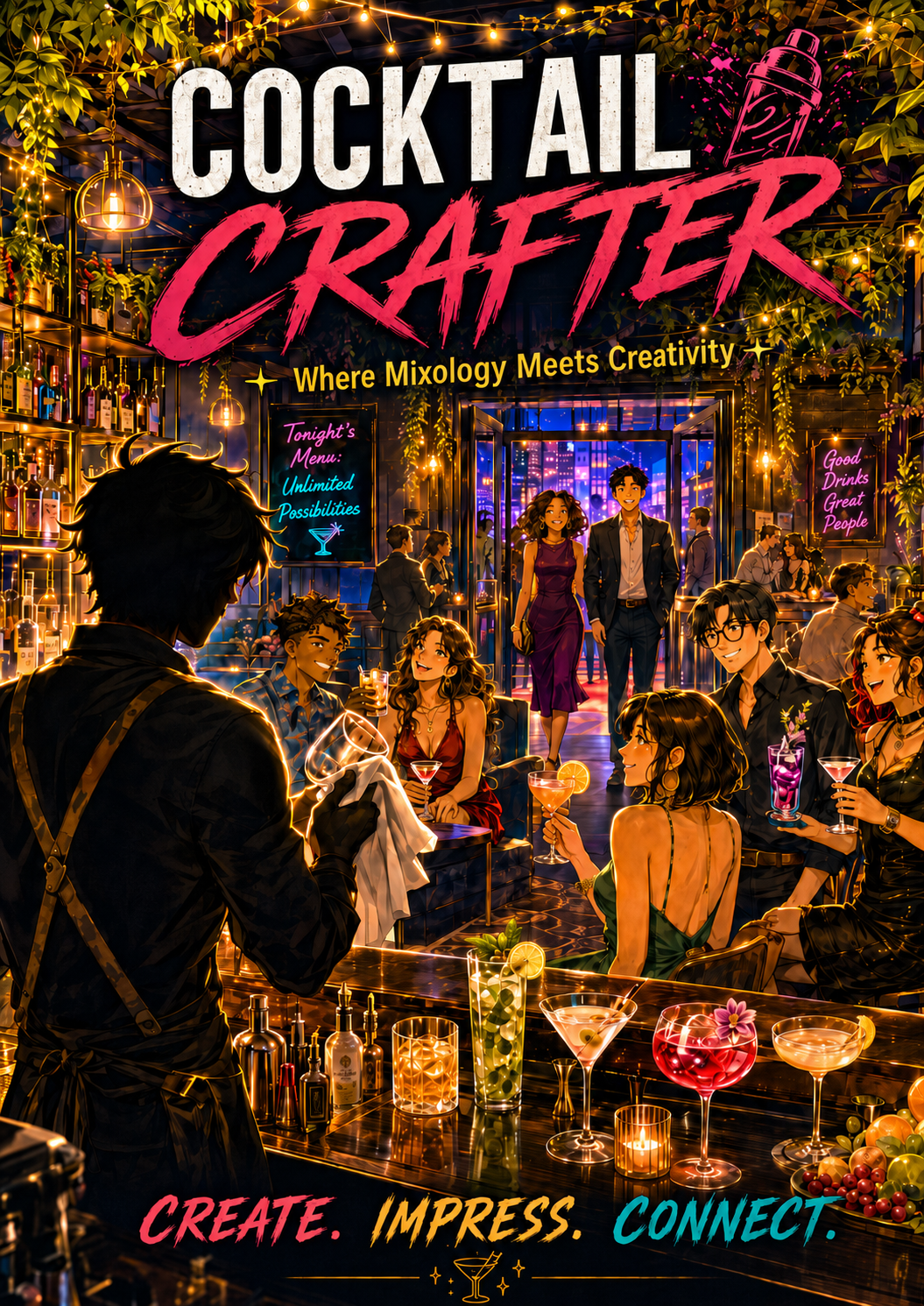
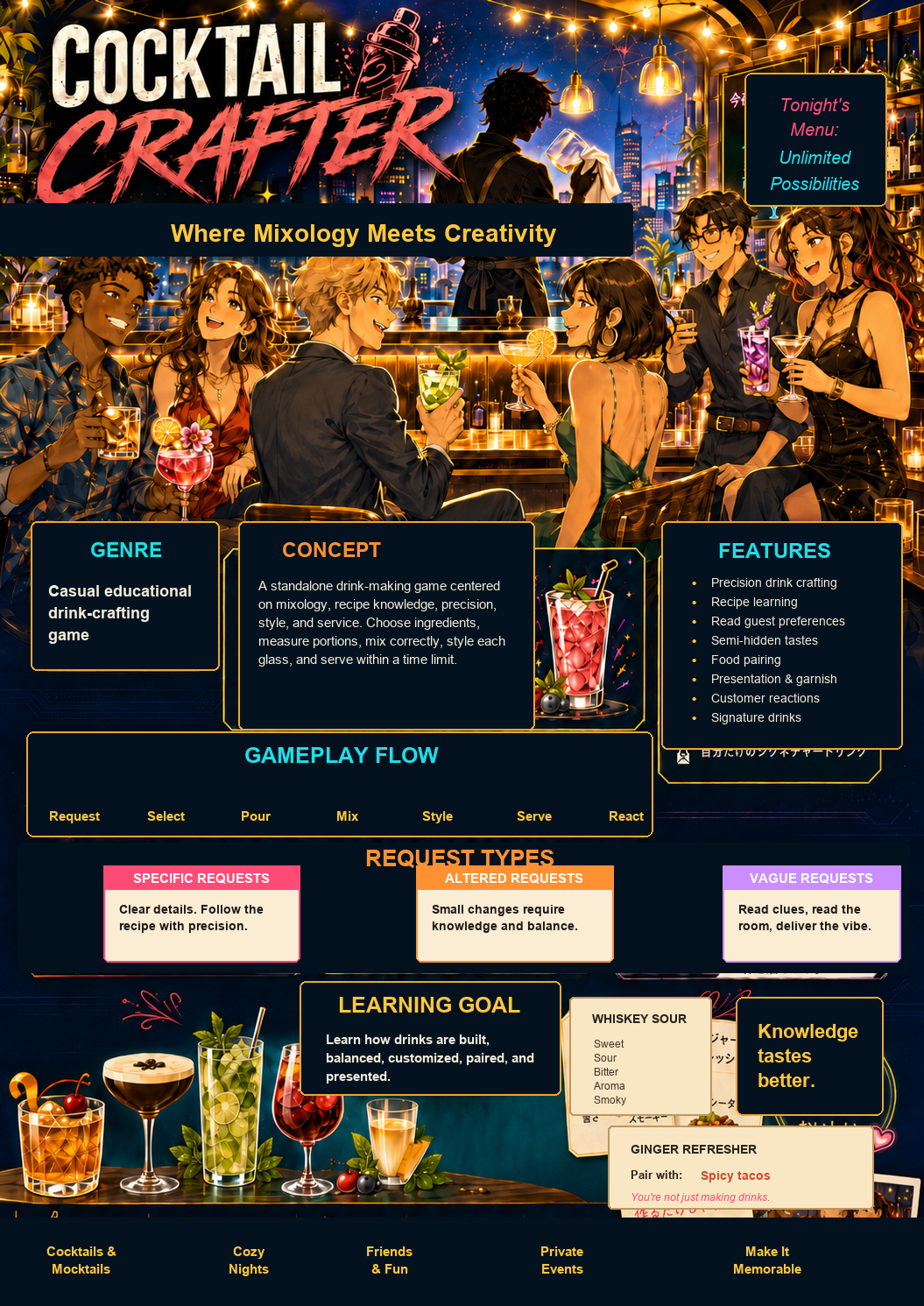
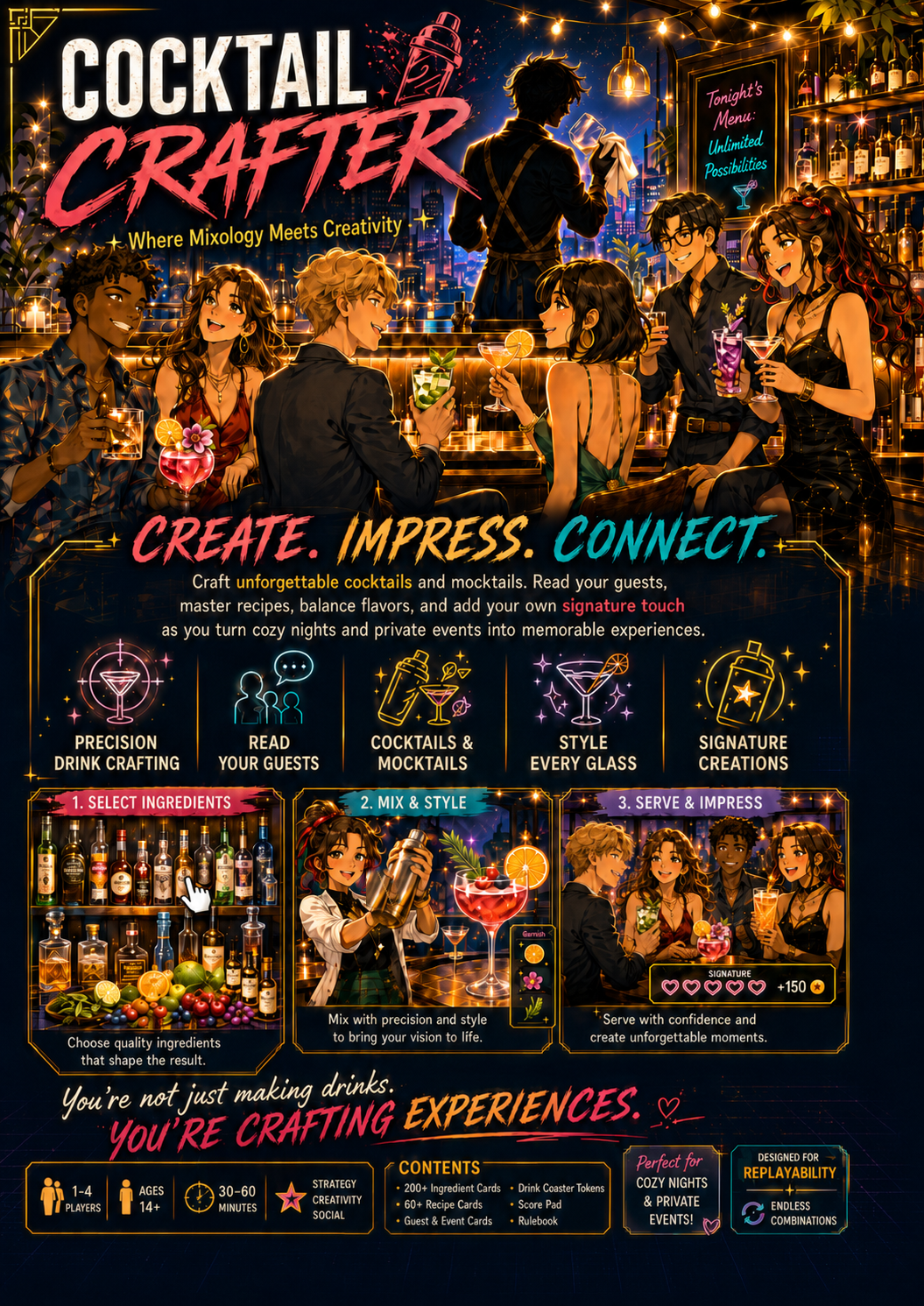
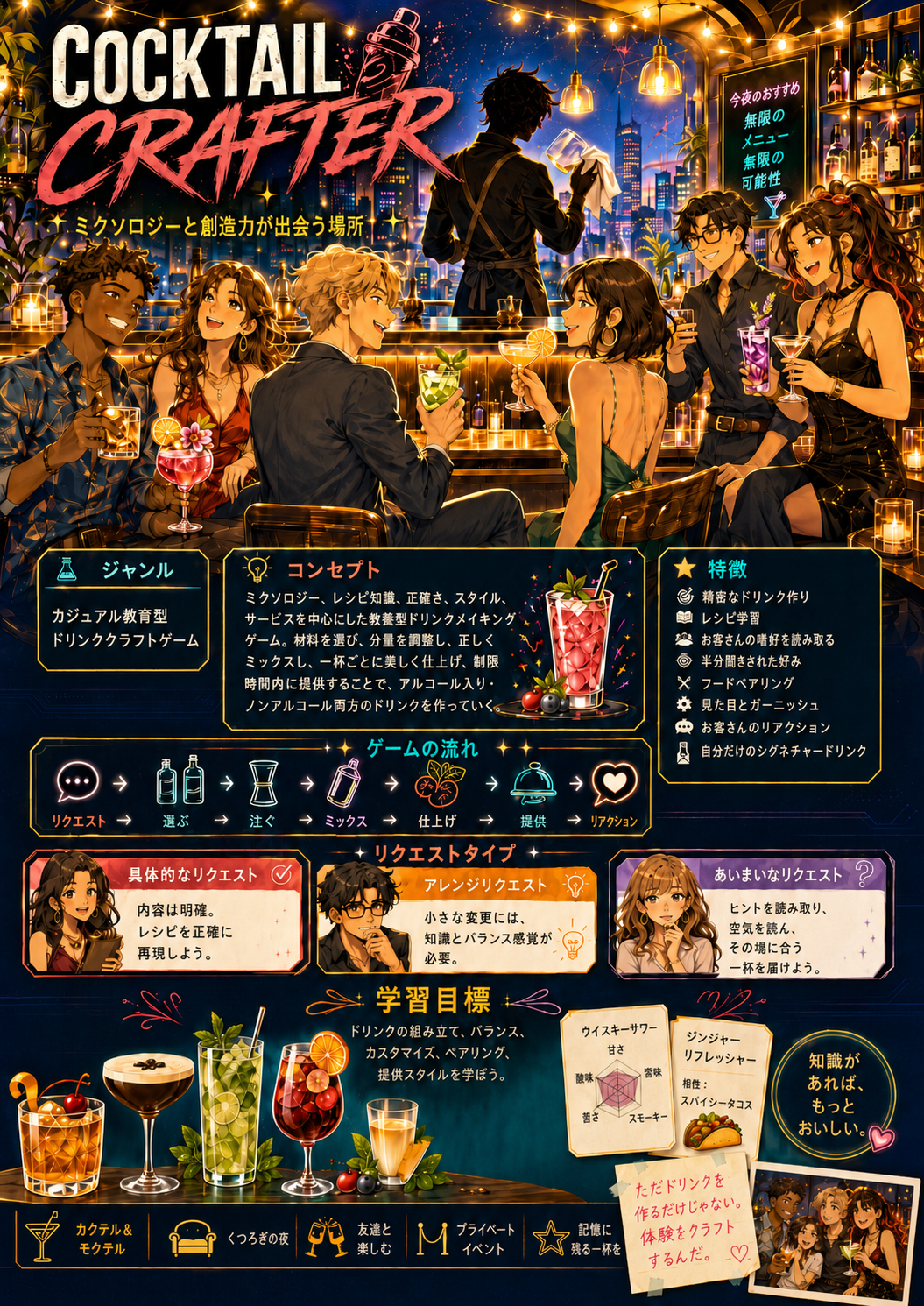
A standalone educational drink-crafting concept about mixology, recipe knowledge, precision, personal style, and reading the people you serve.
ENGLISH FRONT SHEET // OPEN FULL SIZE
Players build alcoholic and non-alcoholic drinks through ingredient selection, portion control, mixing method, glass choice, garnish, presentation, and timed service.
Specific, altered, and vague requests gradually move the player from following recipes to balancing flavors and interpreting semi-hidden guest preferences.
The player grows into a thoughtful host and drink maker who can create signature drinks for close friends, cozy nights, meals, and private events.
The concept teaches recipe structure, portions, flavor balance, methods, presentation, pairing, and customization across cocktails and mocktails.
The identity, player fantasy, core loop, learning goal, guest-preference direction, and bilingual sheet set are defined; deeper mechanics and a playable prototype remain future development.
Select any sheet to inspect the original-resolution file.
PROJECT RECORD // GG-BNY-01
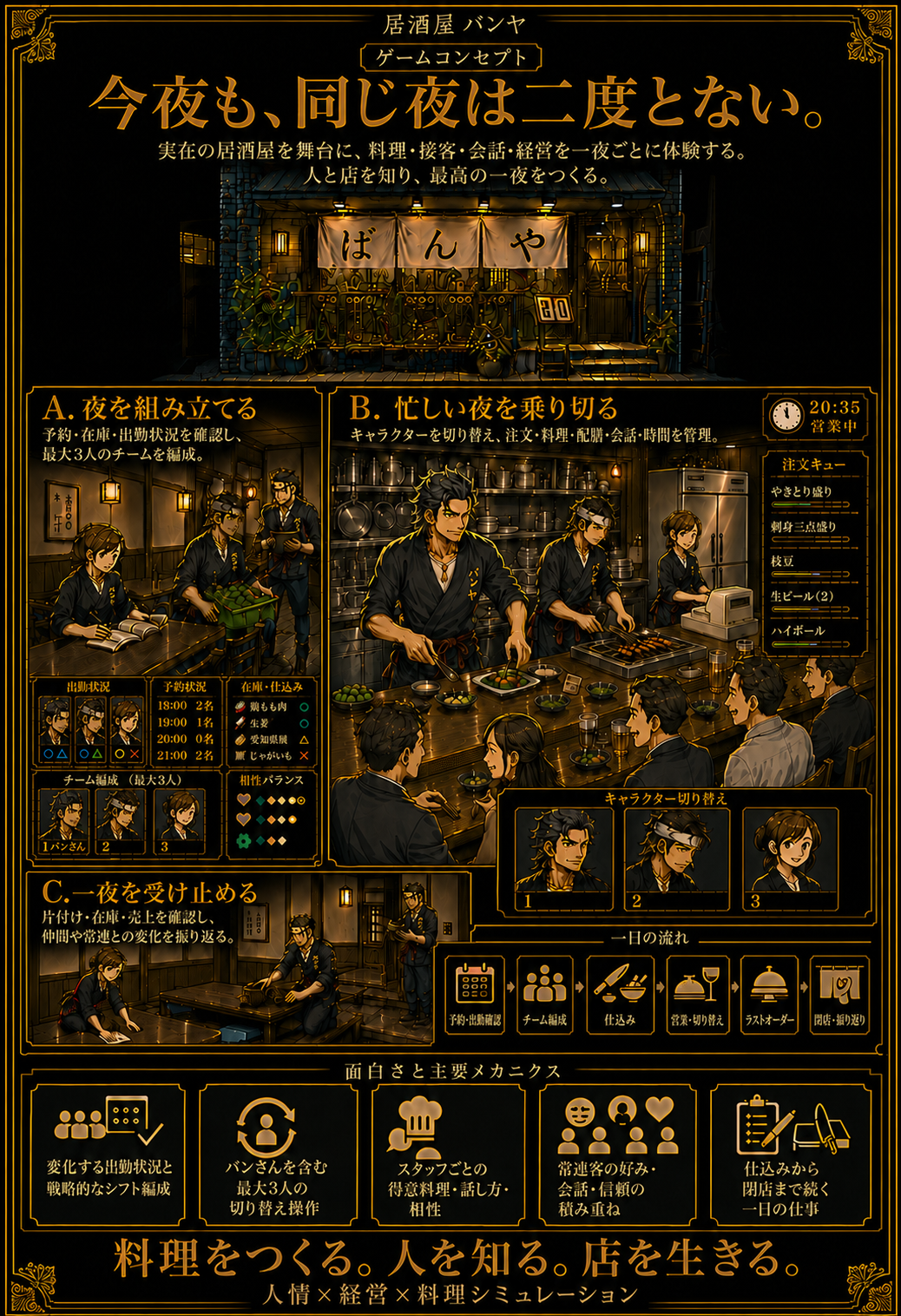
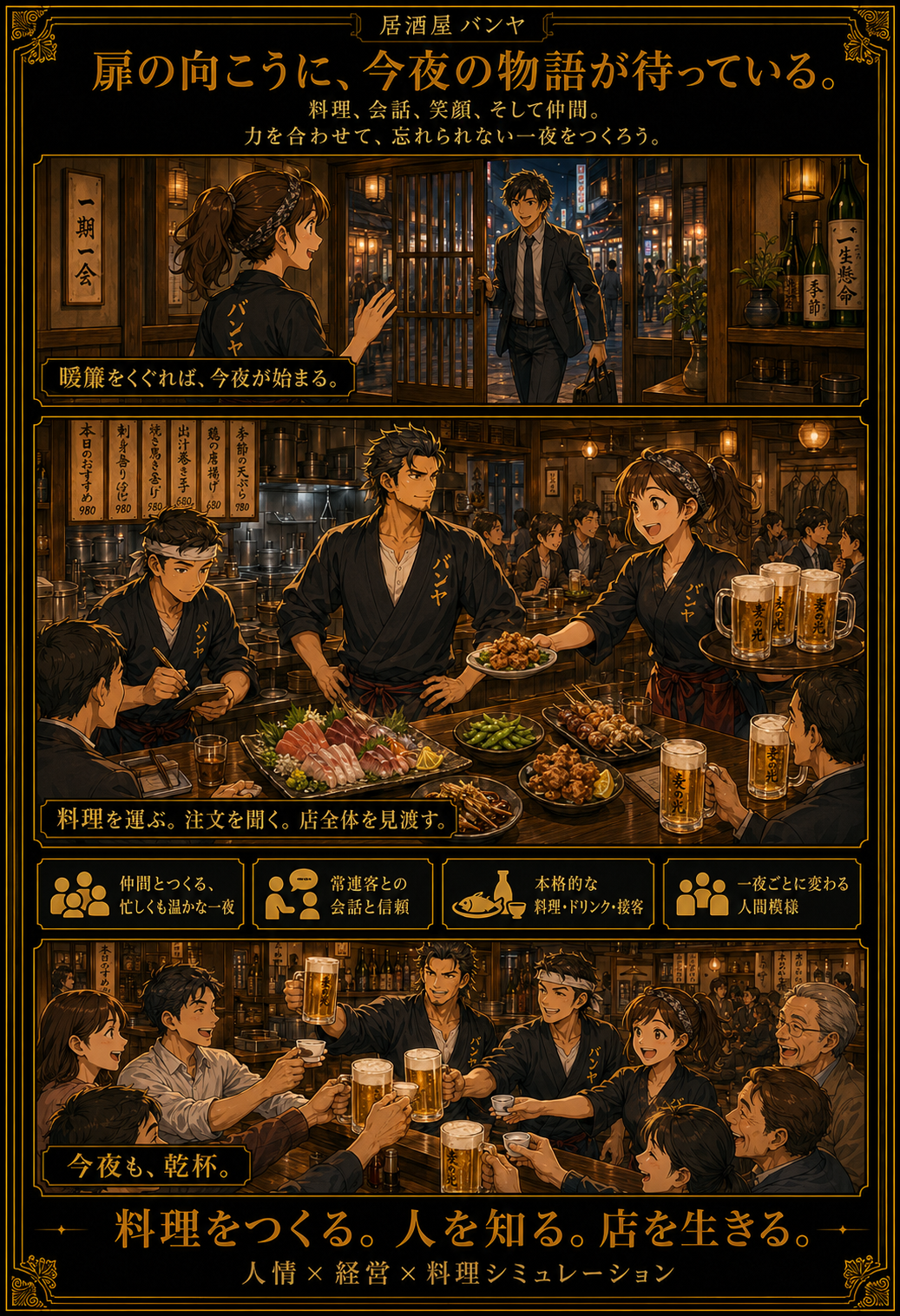
A grounded neighborhood izakaya management, cooking, and hospitality simulation where every shift becomes a different human story.
ENGLISH FRONT // OPEN FULL SIZE
Each shift begins with reservations, attendance, stock, and team planning, then moves through preparation, cooking, drinks, table service, last order, cleanup, sales review, and staff reflection.
Ban-san anchors the restaurant, while unlockable staff bring distinct strengths, limitations, compatibility, and perspectives to cooking, drinks, conversation, reservations, and customer care.
The player becomes the working head master: planning the shift, cooking, supporting staff, reading customers, and protecting the character of the restaurant.
Reservations, stock, seating, orders, staff switching, food, drinks, conversation, closing time, and unexpected events compete for attention throughout each night.
The concept, core flow, hospitality direction, staff framework, and complete English/Japanese six-sheet presentation set are approved and locked. A playable prototype, complete design specification, QA, release packaging, and publication remain future development.
Select any sheet to inspect the original-resolution file.
Experimental builds and early playable tests will be collected here without mixing them into finished game concepts.
Mechanics, interface studies, visual directions, and other design explorations will appear here when selected.
Milestones, revision notes, and development snapshots will appear here as Patch 3 work advances.